
81% ▼ 10 points since April
For architecture and design practices
Know which projects pay for the studio.
Visory runs bookkeeping, payroll, accounts payable, and accounts receivable for Australian architecture and design practices, with a dedicated team and Delphi AI under their oversight. Once a month, Visory Insights shows the directors which projects are recovering their fees and what to do next.
- Every stage claim raised to the client agreement, with variations kept apart until they are signed, so unbilled fees are known at each month-end.
- A named Payroll Officer runs every pay run, checked by Delphi AI before it is paid: architects and graduates under the Architects Award, overtime and time off in lieu, and super inside seven business days.
- Fee recovery by project every month, briefed by your Business Performance Partner, with one move to make.


Who this is for
Built for practices where the directors still design.
If the people who win the work also lead the projects, sign the fee proposals, and approve the pay run, this is the finance function for it.
- Architecture, interior design, and landscape practices of 5 to 100 people, roughly $750k to $20m in fees, led by a director or principal who answers for the result.
- Fees agreed by stage, as a percentage of construction cost, or by the hour, with variations and additional services along the way.
- Registered architects and graduates on salary, with sub-consultants and freelance drafters brought in as each project needs them.
- Time kept in a practice management tool, and project budgets that are only checked when a stage closes.
Anywhere in Australia. Practices whose architects are registered in any state work with the same team, on the same monthly close.
The pressure
Four rules run from the client agreement to the pay run.
An architect’s fee is agreed in writing before the work starts, claimed in stages as the project moves, and earned by salaried people on an award that pays for long weeks. Super runs on its own seven-day clock. Each rule lands in the books, and each one changes what a project really returned.
The client agreement is the billing schedule.
Stages, the fee basis, and how a change is priced all come from it, so invoices are raised to its terms, and work outside it is flagged as a variation while it is happening, not when the stage is billed.
Set by Architects codes of professional conduct, NSW and Victoria
In New South Wales, an architect must have a written agreement with the client that sets out how fees and costs are calculated and paid, enter into it before starting work unless that is not reasonable or the work is urgent, and charge fees that reflect it. In Victoria, no fee may be collected and no service provided, concept sketches included, without a written and signed agreement, and clients receive regular statements of account unless they agree otherwise. Architects in other states work under their own board’s code.
Architects Regulation 2017 (NSW), Schedule 2, clause 7, version current from 1 July 2020; Architects Regulations 2026 (Vic), Schedule 1, clauses 6 and 7, effective 26 April 2026.A stage claim is a cash document with legal weight.
Claims raised on time, against the agreed stage, with the work they cover, keep the practice’s position clear. Whether to use the Act on a late payer is the practice’s decision, with its own legal adviser.
Set by Security of payment Acts
Every state and territory has security of payment law for building and construction. It gives a person who supplies related goods and services under a construction contract a right to progress payments, and in Victoria those services expressly include architectural and design services in relation to construction work. A respondent who does not answer a payment claim with a payment schedule within 10 business days, or sooner if the contract says so, becomes liable for the whole claimed amount. In New South Wales, unless the contract sets other dates, a claim can be made once a month, on the last day of the month. In Victoria, some domestic building contracts are excluded.
Building and Construction Industry Security of Payment Act 2002 (Vic), sections 6, 7, 9 and 15, as in force from 24 June 2026; Building and Construction Industry Security of Payment Act 1999 (NSW), sections 8 and 14, in force from 26 March 2000.Deadline weeks are a payroll cost.
The hours logged against a project before a submission are the hours the award pays for, so timesheets are checked with each pay run, and time off in lieu is tracked until it is taken or paid out.
Set by Architects Award 2020 (MA000079)
The Architects Award covers graduates of architecture and registered architects, and sets rates for students of architecture. Ordinary hours are up to 38 a week, between 8.00 am and 6.00 pm Monday to Friday. Time worked beyond or outside them is paid at 150% of the minimum hourly rate, or under another arrangement that is agreed, fair to the employee, and recorded in writing; the award sets no salary level above which overtime stops applying. Time off instead of overtime is taken within six months, at time and a half.
Architects Award 2020 (MA000079), clauses 4, 12 and 17, as varied from 1 August 2023; Annual Wage Review, effective each 1 July; Fair Work Act 2009 and Fair Work Regulations 2009, records kept for seven years.A freelance drafter’s invoice can start a super clock.
Bills from people paid for their own labour are checked as they arrive, so super on the labour part reaches the fund inside the same window as the salaried team’s.
Set by Payday Super
Super guarantee contributions must be received by each employee’s fund within seven business days after payday, with enough information to allocate them. Super is also due for independent contractors paid mainly for their labour, and for a contractor paid by invoice, payday is the day the invoice is paid. The Small Business Superannuation Clearing House has closed.
Australian Taxation Office, Payday Super; effective 1 July 2026.Every instrument named here is listed with its effective date at the foot of this page.
How much of last quarter’s time went on work nobody agreed to pay for? A senior member of the Visory team can work through your projects, fees, and timesheets with you, free of charge, before anything is agreed.
Book a discovery callWhat we run for architecture and design practices
From accurate processing to leadership confidence.
Visory Insights leads. The basics underneath it make it trustworthy and free your team for the work that matters, run by a dedicated team with Delphi AI under their oversight.Flat monthly fee. No hourly billing.
- 1 Accurate processing Bookkeeping and payroll done right, every month.
- 2 Clean, reliable data The foundation that makes reporting defensible.
- 3 Meaningful insights Cash, margin, and the year ahead, explained.
- 4 Leadership confidence You present numbers you trust. The plan gets backed.
The leading service
Visory Insights
Fee recovery, utilisation, unbilled stages, and debtor days, explained once a month with one move to make. A named Business Performance Partner who reads the projects with the directors before the next fee proposal or the next hire.
See how Visory Insights works- Monthly plain-English report
- Structured session with your leadership team
- Twelve-month forward view of cash
- A named Business Performance Partner
The basics underneath it
Bookkeeping
Fees, reimbursables, and costs coded by project and stage, with sub-consultant fees you on-charge tracked until they reach an invoice.
Explore bookkeepingPayroll
Architects Award and salaried pay runs, overtime and time off in lieu tracked, Single Touch Payroll, and super inside seven business days.
See how payroll runsAccounts payable
Sub-consultant, printing, model-making, and software bills captured, coded to the project they served, and paid when you approve them.
See accounts payableAccounts receivable
Stage claims and variation invoices raised to the client agreement, sent in your name, and followed up on a cadence you agree.
See accounts receivableRegistration, CPD, and insurance stay with your architects and your broker. Each state’s board sets what an architect must hold and complete. Visory pays those bills, tracks their cost, and runs the practice’s bookkeeping, payroll, payables, and receivables, without giving regulatory or legal advice.
Visory Insights for architecture and design practices
One month of Visory Insights on an architecture practice.
Visory Insights reads the month and names the move to make. Here is September for Meridian Architects, a fictional practice with about $3.6m in fees and 22 people.
The studio is as busy as it was in April, at 77% utilisation, but more of its time is going on work outside the agreed fees. September recorded $370k of time at standard rates and earned $300k in fees.
Time on unagreed variations $96k At Risk $66k past the $30k the practice lets build before a variation is signed: design changes on three projects since June, none put to the client in writing
Fee recovery Agreeing September’s $26k of variation time as fees lifts recovery from 81% to 88%, close to the target
Put the three variations to the clients in writing this week, and pause out-of-scope work on each until it is signed. The out-of-scope time on each project, set against its client agreement, is listed for your session.
≈ $96k of fees to agree Insight session Accepted 9:00 to 9:45am · Video call  With your Business Performance Partner
Prepared and checked by Delphi AI, and briefed by your Business Performance Partner, in plain English, ahead of the directors’ meeting.
- Monthly plain-English report
- Structured insight sessions
- Fee recovery and utilisation, project by project
Which of your projects is running past its fee? A discovery call is a conversation about how you price, how you claim stages, and what the directors want to see each month.
Book a discovery callFits your stack
Works with the tools you already use.
Your ledger and your payroll stay where they are. Visory connects to them and keeps the data flowing every day, so your team and Delphi are working from current numbers.
Accounting and books
Where your ledger and reporting live.


Payroll and people
Pay runs, Single Touch Payroll reporting, and the people behind them.
-

-
 Xero Payroll
Project and practice management
Projects, stages, fees, and timesheets stay in the practice management tool your studio already runs, whether Deltek, Monograph, or another. Visory reads billed fees, unbilled stages, and hours from it at each month-end, and matches payments to the ledger through daily bank feeds.
Resources for architecture and design practices
Content written for architecture and design practices by the expert teams at Visory.



Common questions
Straight answers for architecture and design practices.
The questions directors and practice managers ask before they hand Visory the finance function. The general ones are on the common questions page.
How do you handle stage billing for architecture projects?
Each project is set up from its client agreement: the stages, the fee for each, and whether fees are fixed, a percentage of construction cost, or hourly. When a stage is reached, or on the claim dates the agreement sets, the claim is prepared, you approve it, and it is sent in your name and followed up until it is paid.
Can you track work in progress against each project fee?
Yes. At each month-end, hours and costs are read from your practice management tool and set against the fee for the stage underway, so you see which projects have used more of their fee than the work completed, and which stages are finished but not yet claimed. Both come to the top of the monthly read.
How do you handle variations and additional services?
Time recorded against work outside the client agreement is kept apart from the stage it sits in and listed by project each month, so a change the client asked for becomes a variation to agree, not a loss found at the end of the stage. Once a variation is signed, it is invoiced on the terms it sets.
Which award covers architects and graduates?
The Architects Award 2020 (MA000079), which covers graduates of architecture and registered architects and sets rates for students of architecture. It has no salary level above which overtime stops applying, and it requires an annual review of each graduate’s progress toward registration. Engineers doing professional engineering work are generally covered by the Professional Employees Award instead. Your Payroll Officer records which award covers each person, and Delphi AI checks every run against it.
Do salaried architects get paid overtime?
Under the Architects Award, time worked beyond 38 ordinary hours a week, or outside 8.00 am to 6.00 pm on weekdays, is paid at 150% of the minimum hourly rate, or under another arrangement that is agreed, fair to the employee, and recorded in writing. Time off instead of payment is taken within six months, at time and a half. Visory tracks the hours and the time off owed with every pay run.
Can an architect make a payment claim under security of payment law?
Often, where the services relate to construction work. Security of payment law in every state and territory gives a right to progress payments for related services under a construction contract, and Victoria’s Act names architectural and design services expressly. Whether a particular project is covered, and whether to use the Act, is a question for your legal adviser. What Visory keeps is the record: claims raised on time, against the agreed stage, with the work they cover. This is general information, not legal advice.
Can you track registration, CPD, and PI insurance costs?
Yes. Registration renewals, CPD, professional indemnity premiums, and memberships are coded as the practice’s fixed costs and spread across the months they cover, so the monthly result is not distorted by one large renewal. What each architect must hold and complete is set by their state’s board and stays with them.
How do you handle sub-consultant fees we pass on to clients?
Engineers, surveyors, and other consultants you engage are paid through accounts payable, coded to the project, and tracked until the fee is on-charged on the client’s invoice. Freelancers paid for their own labour are checked for super as their invoices arrive. Each month, paid sub-consultant costs are checked against what has been billed, so nothing recoverable is left off.
How much does Visory cost?
Visory charges one flat monthly fee for the scope we agree. No timesheets, no hourly billing, no surprises. The fee reflects the services you take and the volume of work in your practice, from the number of projects billed to the size of the pay run, so you know the monthly cost before you start.
See how pricing works More questions, longer answers. Every question has its own link. See all common questions
General information for architecture and design practices, not financial or tax advice.
Getting started
Start with clarity, not a contract.
Three steps, in whatever rhythm suits you. Each one is useful on its own.
-

Book a discovery call
An obligation-free conversation about how your practice prices work, claims stages, and what the directors want the numbers to show.
Obligation-free -

Get your free financial health check
A senior member of the Visory team analyses your financials and shows where your finance function can improve. See the clarity before you commit to anything.
Free · your own numbers -
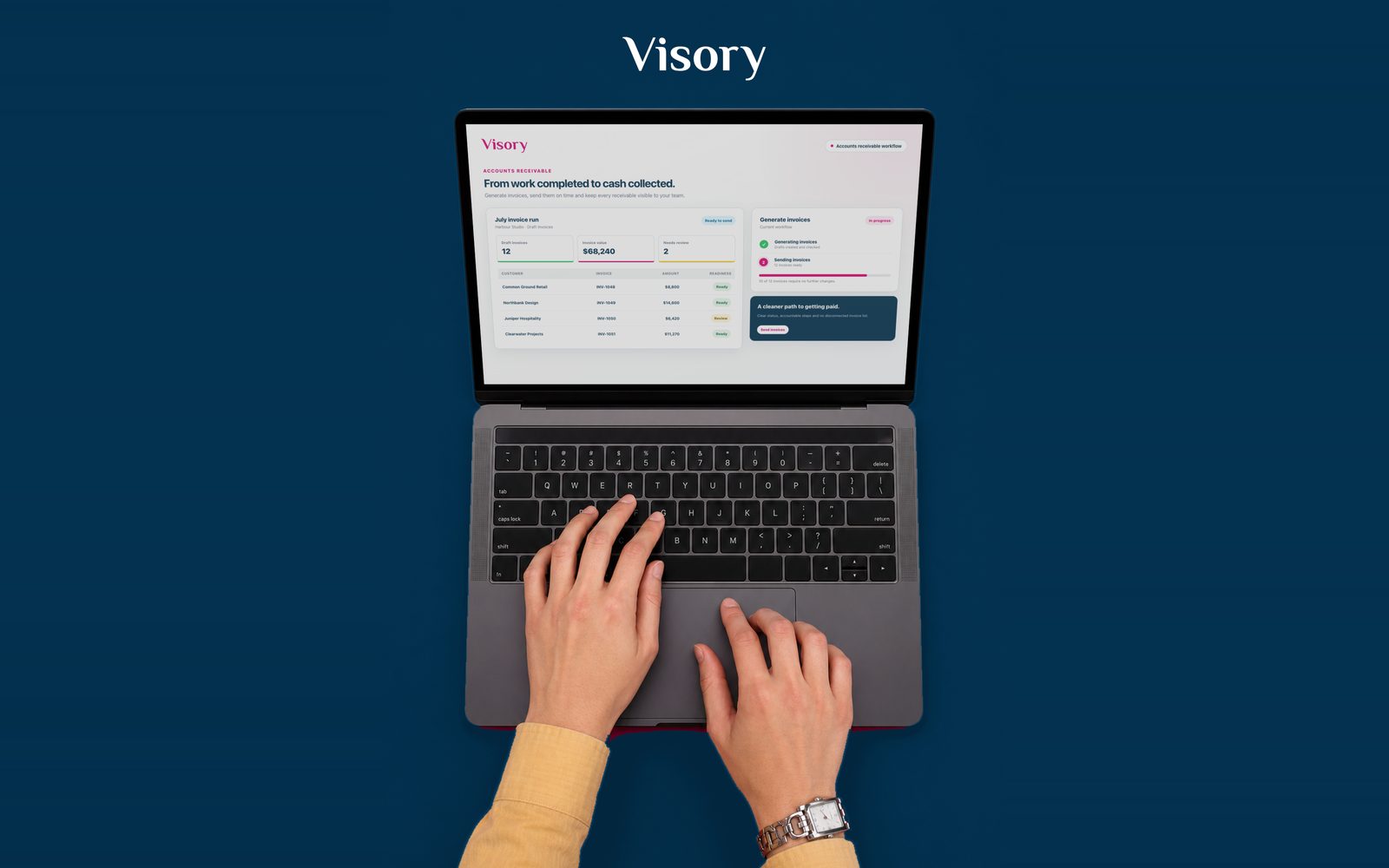
See how Visory works in practice
A walkthrough of Visory running stage billing, payroll, and the monthly read for a practice of your size. If it fits, we agree a flat monthly scope.
Flat monthly fee
Get started
Price the next project on what the last one really took.
Start with a discovery call. Then a senior member of the Visory team runs the free financial health check on your own numbers and shows you where fees are leaking between the timesheet and the invoice.
Sources (8) · rules last checked 8 October 2026
- NSW Architects Code of Professional Conduct, Architects Regulation 2017 (NSW), Schedule 2: clause 7 (client agreements), clause 15 (professional indemnity insurance), and clause 16 (continuing professional development); version current from 1 July 2020.
- Victorian Architects Code of Professional Conduct, Architects Regulations 2026 (Vic), Schedule 1: clause 6 (written and signed client agreements) and clause 7 (statements of account, and fees within the agreed fee structure), effective 26 April 2026.
- Building and Construction Industry Security of Payment Act 2002 (Vic), sections 6 (related goods and services, including architectural and design services), 7 (application, and domestic building exclusions), 9 (rights to progress payments), and 15 (payment schedules), as in force from 24 June 2026.
- Building and Construction Industry Security of Payment Act 1999 (NSW), sections 8 (reference dates) and 14 (payment schedules), in force from 26 March 2000; NSW Government, Building Commission NSW, security of payment guidance.
- Architects Award 2020 (MA000079): clause 4 (coverage), clause 12 (ordinary hours), clause 13 (minimum rates and annual review), and clause 17 (overtime, and time off instead of overtime), as varied from 1 August 2023; Fair Work Commission, Annual Wage Review, effective each 1 July.
- Professional Employees Award 2020 (MA000065), clause 18: overtime above 38 hours a week, and the exemption for salaries 25% or more above the award minimum, effective 16 September 2023.
- Fair Work Act 2009 and Fair Work Regulations 2009: time and wages records kept for seven years.
- Australian Taxation Office, Payday Super: contributions received within seven business days of payday, and for contractors paid mainly for their labour by invoice, the payday is the date the invoice is paid; effective 1 July 2026.