
9% ▼ 3.0 pts since April
For multi-site operators
Run every site on numbers you can compare.
Visory runs bookkeeping, payroll, accounts payable and accounts receivable for Australian businesses that operate across several sites, from franchise networks to hospitality groups, with a dedicated team and Delphi AI under their oversight. Once a month, Visory Insights reads each site against the others and shows where to act next.
- A profit and loss for every site and one for the group, closed on the same timetable each month, with intercompany charges matched on both sides.
- One payroll across every entity, run by a named Payroll Officer and checked by Delphi AI, whichever award, state, or roster each site runs on.
- Site against site, every month, briefed by your Business Performance Partner, with the one site to act on first.


Who this is for
Built for owners who run several sites as one business.
If each site has its own entity, its own roster, and its own takings, but you answer for the total, this is the finance function for it.
- Two to twenty sites, venues, or centres in retail, services, hospitality, health, childcare, or fitness.
- Roughly $1m to $20m in revenue, led by an owner or CEO accountable for the whole group’s result.
- Several companies or trusts, often one per site and a head entity, with staff on more than one award and sometimes in more than one state.
- Books kept entity by entity, with the group view rebuilt in a spreadsheet when someone asks for it.
Anywhere in Australia. Groups with sites in several states work with one team, on one monthly close.
The pressure
Four rules read your sites as one business, even when your books do not.
Separate entities do not mean separate obligations. The state counts the group’s wages together, the ATO can take GST from the group as one, and every employing entity answers to the same rules on super and pay records. The finance function is where the group gets seen whole.
Payroll tax is a group number.
Wages are counted across every entity, so a new site or a new hire in one company moves the tax for all of them, and the forecast has to be made at group level.
Set by Payroll Tax Act 2007 (NSW), Part 5
Businesses are grouped when they are related corporations, use common employees, are under common control of more than 50%, or are linked by tracing of interests, wherever in Australia they employ. Only one member of a group can claim the tax-free threshold, and every member is jointly and severally liable for tax another member fails to pay.
Payroll Tax Act 2007 (NSW), sections 70 to 73 and 81; Revenue NSW, payroll tax grouping; in force from 1 July 2007.One return is only as right as the weakest set of books.
Outside a group, each entity lodges its own and intercompany charges carry GST both ways. Inside one, every entity’s ledger has to close on time for the group to report.
Set by GST Act 1999, Division 48
Companies, trusts, and partnerships with common ownership can form a GST group. One representative member reports and pays GST for every member, the members share a tax period and accounting basis, sales between members are ignored for GST, and every member is jointly and separately responsible for what the representative member owes.
A New Tax System (Goods and Services Tax) Act 1999, Division 48, section 48-40; Australian Taxation Office, GST groups; in force from 1 July 2000.Each employing entity runs its own clock.
Sites paid on different cycles mean several super deadlines in a week, each tied to the payday of the company that employs the staff.
Set by Payday Super
Super guarantee contributions are on time only if the fund receives them, with the details it needs to allocate them, within seven business days after the employee is paid. A new employee’s first contribution has 20 business days. The Small Business Superannuation Clearing House has closed, and late contributions attract the super guarantee charge.
Australian Taxation Office, Payday Super for employers; effective 1 July 2026.Staff who work at two sites need the right employer on every shift.
A manager or casual rostered across two entities has hours recorded and paid by each one, under the award that covers the work.
Set by Fair Work Act 2009, section 535
Time and wages records are kept for seven years, readily accessible to a Fair Work Inspector, legible, in English, and never changed except to correct an error. An employer that has not kept them may have to prove to a court that it did not underpay.
Fair Work Act 2009, sections 535 and 539; Fair Work Regulations 2009, regulations 3.31 to 3.44; in force from 1 July 2009.Every instrument named here is listed with its effective date at the foot of this page.
Which of your sites is carrying the others? A senior member of the Visory team can show you on your own numbers, site by site, before anything is agreed.
Book a discovery callWhat we run for multi-site operators
From accurate processing to leadership confidence.
Visory Insights leads. The basics underneath it make it trustworthy and free your team for the work that matters, run by a dedicated team with Delphi AI under their oversight.Flat monthly fee. No hourly billing.
- 1 Accurate processing Bookkeeping and payroll done right, every month.
- 2 Clean, reliable data The foundation that makes reporting defensible.
- 3 Meaningful insights Cash, margin, and the year ahead, explained.
- 4 Leadership confidence You present numbers you trust. The plan gets backed.
The leading service
Visory Insights
Margin by site, against the other sites and the group, explained once a month with one move to make. A named partner who reads the whole group with you before the next site, lease, or hire is decided.
See how Visory Insights works- Monthly plain-English report
- Structured session with your leadership team
- Twelve-month forward view of cash
- A named Business Performance Partner
The basics underneath it
Bookkeeping
Each entity’s ledger on one chart of accounts, intercompany charges matched on both sides, and the group brought together every month.
Explore bookkeepingPayroll
One pay run across every entity, each employee paid by the right employer under the right award, reported through Single Touch Payroll, with super inside seven business days.
See how payroll runsAccounts payable
Supplier bills coded to the site that used them, shared costs split by a rule you agree, and paid when you say so.
See accounts payableAccounts receivable
Account customers invoiced and followed up in your name, with what each site is owed in plain view.
See accounts receivableStructure and tax advice sit outside the service. Choosing entities, forming or leaving a GST group, and seeking exclusion from a payroll tax group are decisions Visory does not make or advise on. Visory keeps each entity’s books and pay records ready for them.
Visory Insights for multi-site operators
One insight, start to finish, across six sites.
Reports tell you what happened. Visory Insights tells you what it means, and what to do about it. Here is one month for Ridgeline Fitness, a fictional group of six studios in New South Wales and Queensland, each in its own company, at about $9m in revenue.
Five studios are holding their margin. Newstead, the newest, added classes faster than members joined. Three points of group margin on $9m is $270k a year.
Staff cost, Newstead studio 50% At Risk 15 points past the 35% the other five studios run at, driven by weekday midday classes that run under a third full
Operating margin, whole group Bringing Newstead’s staff cost to 35% of its $1.2m revenue is worth $180k a year, two points of group margin
Fold Newstead’s weekday midday classes from four into two, and move the studio onto the roster the other five run. The revised timetable and roster are prepared for your session.
≈ +$180k a year Insight session Accepted 9:00 to 9:45am · Video call  With your Business Performance Partner
With your Business Performance Partner
Prepared by Delphi AI, briefed by your Business Performance Partner, in plain English, site by site and for the group as a whole.
- Monthly report for every site and the group
- Structured insight sessions
- Each site’s margin ranked against the others
See your sites side by side. A discovery call is a conversation about your entities, your sites, and what you want to compare each month.
Book a discovery callFits your stack
Works with the tools you already use.
Your ledger and your payroll stay where they are. Visory connects to them and keeps the data flowing every day, so your team and Delphi are working from current numbers.
Accounting and books
Where your ledger and reporting live.


Payroll and people
Pay runs, Single Touch Payroll reporting, and the people behind them.
-

-
 Xero Payroll
Point of sale, rostering, and a ledger per entity
Takings from the point-of-sale or booking system each site runs, such as Square, Lightspeed, or Mindbody, matched to daily bank feeds. Your rostering and time-and-attendance tools feed one pay run, and each entity keeps its own file in your accounting system.
Resources for multi-site operators
Content written for multi-site operators by the expert teams at Visory.



Common questions
Straight answers for multi-site operators.
The questions multi-site owners ask before they hand Visory the finance function. The general ones are on the common questions page.
Can you consolidate the books across our entities?
Yes, as a management view. Each entity keeps its own file in Xero, MYOB, or QuickBooks, set up on one chart of accounts so the lines mean the same thing everywhere. Each month, intercompany balances are matched and taken out, and you get a profit and loss and balance sheet for the group with every site beside it. Statutory consolidated financial statements are outside the service.
How do you handle intercompany transactions?
Management fees, recharges, and loans between entities are recorded on both sides as they happen and reconciled at every month-end, so the two ledgers agree. Shared costs such as head office wages, software, and insurance are split across sites by a rule you agree once, so every site carries its share the same way each month.
Can one payroll cover staff in several entities and awards?
Yes. Every employee is paid by the entity that employs them, under the award that covers the work: the General Retail Industry Award (MA000004), the Hospitality Industry (General) Award (MA000009), the Fitness Industry Award (MA000094), the Children’s Services Award (MA000120), or others. Delphi AI prepares and checks the routine work from your rostering data, your Payroll Officer oversees it, and you approve it before it is paid. Staff who work across entities have their hours recorded against the right employer.
How does payroll tax grouping affect a multi-site business?
Related businesses are grouped, wherever in Australia they employ, and only one member of the group can claim the tax-free threshold, so the wages of every entity count toward one total. Visory reports wages by entity and by state each month, so the group’s position is visible before a return is due. Whether your entities are grouped, or can be excluded, is a tax question Visory does not advise on.
Does each of our entities lodge its own BAS?
Unless they are in a GST group, yes. In a GST group, one representative member reports GST for every member on one activity statement, and sales between members are ignored for GST. Either way, Visory keeps each entity’s ledger closed on the same timetable and prepares the activity statement figures from it. This is general information, not tax advice.
Can we see profit by site when one entity runs several sites?
Yes. Every sale, bill, and wage is tagged to the site it belongs to, using tracking categories or classes in your accounting system, so one company running three venues still reports three results. Your Business Performance Partner reads them side by side each month and names the site to act on first.
What happens when we open or buy another site?
The new site is set up on the same chart of accounts, its staff are brought onto the same payroll under the right entity and award, and it appears in the next monthly report beside the others. If it sits in a new entity, it is added to the group view, and its wages are counted toward the group’s payroll tax position from its first pay run.
Do you work with our point-of-sale and rostering systems?
Yes, whichever you run. Daily takings from each site’s point-of-sale or booking system are matched to the bank, and approved rosters and timesheets feed your payroll system. Your systems, your ledgers, and your payroll all stay where they are.
How much does Visory cost?
Visory charges one flat monthly fee for the scope we agree. No timesheets, no hourly billing, no surprises. The fee reflects the services you take and the volume of work across the group, from the number of entities and sites to the size of the pay run, so you know the monthly cost before you start.
See how pricing works More questions, longer answers. Every question has its own link. See all common questions
General information for multi-site operators, not financial or tax advice.
Getting started
Start with clarity, not a contract.
Three steps, in whatever rhythm suits you. Each one is useful on its own.
-

Book a discovery call
An obligation-free conversation about your sites, your entities, and what you want to compare each month.
Obligation-free -

Get your free financial health check
A senior member of the Visory team analyses your financials and shows where your finance function can improve. See the clarity before you commit to anything.
Free · your own numbers -
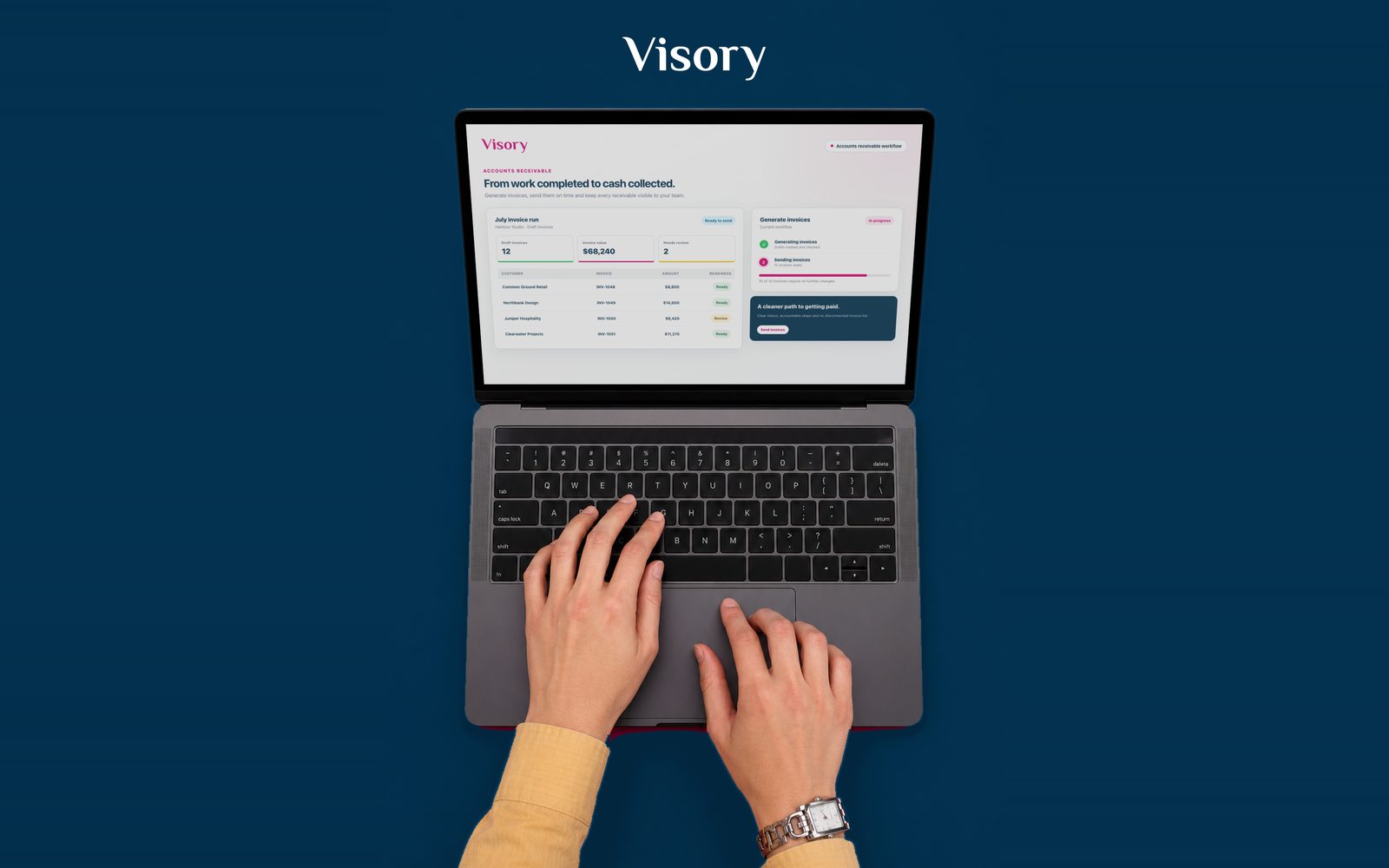
See how Visory works in practice
A walkthrough of the finance function and Insights on a multi-site group like yours, entity by entity. If it fits, we agree one flat monthly scope.
Flat monthly fee
Get started
See every site on the same page, every month.
Start with a discovery call. Then a senior member of the Visory team analyses your numbers, site by site and free of charge, and shows you where the finance function can improve.
Sources (5) · rules last checked 8 October 2026
- Payroll Tax Act 2007 (NSW), Part 5 (Grouping of employers), sections 70 to 73 (related corporations, common employees, common control, tracing of interests) and section 81 (joint and several liability), in force from 1 July 2007; Revenue NSW, payroll tax grouping and Commissioner’s Practice Note 009.
- A New Tax System (Goods and Services Tax) Act 1999, Division 48 (GST groups), section 48-40, in force from 1 July 2000; Australian Taxation Office, GST groups.
- Australian Taxation Office, Payday Super for employers: contributions received within seven business days after payday, 20 business days for a new employee’s first contribution, effective 1 July 2026.
- Fair Work Act 2009, sections 535 and 539, and Fair Work Regulations 2009, regulations 3.31 to 3.44: time and wages records kept for seven years, in force from 1 July 2009.
- General Retail Industry Award 2020 (MA000004); Hospitality Industry (General) Award 2020 (MA000009); Fitness Industry Award 2020 (MA000094); Children’s Services Award 2010 (MA000120).