
82% ▼ 9 pts since April
For consulting firms
Books and payroll that show which engagements actually pay.
Visory runs bookkeeping, payroll, accounts payable and accounts receivable for Australian consulting firms, with a dedicated team and Delphi AI under their oversight. Once a month, Visory Insights shows how utilisation, realisation and cash are tracking, and what to do next.
- Every engagement invoiced on its own terms, whether retainer, fixed fee, or time and materials, with unbilled time read from your timesheets at each month-end.
- A named Payroll Officer runs every pay run, checked by Delphi AI before it is paid: each consultant against the right award or none, associate super where it applies, and super within seven business days.
- Utilisation and realisation every month, by consultant and by engagement, briefed by your Business Performance Partner with one move to make.


Who this is for
Built for firms that sell advice by the day.
If your fees come from engagements, your capacity comes from consultants and associates, and the directors still price the work, this is the finance function for it.
- Firms of 5 to 100 people and roughly $750k to $20m in fees, led by a managing director or principal who answers for the result.
- Fees from retainers, fixed-fee engagements, and time and materials, with day rates set consultant by consultant.
- A core team of salaried consultants, with associates brought in as sole traders or through their own companies.
- Time kept in a timesheet or engagement tool, and utilisation worked out in a spreadsheet when someone finds the time.
Anywhere in Australia. Firms with consultants on client sites across the country work with the same team, on the same monthly close.
The pressure
Four rules decide what a consultant really costs.
Most consulting firms run on a core team and a bench of associates brought in as engagements land. Who counts as staff, who is owed super, what is withheld, and which award applies are each settled by a different rule, and each one lands in the pay run or the bills.
One associate can need two answers.
A senior associate embedded in a client team for a year, working to your direction, can be a contractor on paper and an employee in practice. The books keep the record that question starts from: who you engage, for how long, on what terms, and at what cost.
Set by Fair Work Act 2009, section 15AA; ATO, TR 2023/4
Under the Fair Work Act, whether a worker is an employee turns on the real substance and practical reality of the whole relationship, including how the contract is performed in practice. For tax and super, the ATO looks at the legal rights and obligations in the contract itself. A contractor earning above the contractor high income threshold can give a written notice opting out of the Fair Work test.
Fair Work Act 2009, sections 15AA to 15AD, effective 26 August 2024; Australian Taxation Office, Taxation Ruling TR 2023/4.The name on the contract decides the super.
The same consultant billing as a sole trader or through their own company carries different obligations, so every associate bill is checked against the party you contracted with, and super, where it applies, is paid with the bill.
Set by SG (Administration) Act 1992, section 12(3); Payday Super
An individual contracted mainly for their labour, paid for their skills and time rather than a result, and required to do the work themselves, is an employee for super guarantee purposes. A contract with their company, trust or partnership is not. Where super applies, it must reach the fund within seven business days of the day the invoice is paid.
Superannuation Guarantee (Administration) Act 1992, section 12(3); Australian Taxation Office, Super for independent contractors; Payday Super, effective 1 July 2026.An associate who is really staff is a withholding gap.
If the tax answer is employee, every payment belonged in the pay run. Associates are set up as suppliers once their ABN and terms are on file, and a bill with no ABN is held for withholding, never paid in full.
Set by Taxation Administration Act 1953, Schedule 1
A business must withhold from salary, wages, bonuses and allowances it pays to an individual as an employee. A genuine contractor’s invoice has nothing withheld, unless the supplier does not quote an ABN, when the business generally withholds tax at the top rate and pays it to the ATO.
Taxation Administration Act 1953, Schedule 1, sections 12-35 and 12-190; Australian Taxation Office, Taxation Ruling TR 2002/9.A strategy consultant and a data engineer on one project can have different minimums.
Each person’s award, or award-free status, is recorded when they join, and salaries near the 25% line are checked against long weeks before the pay run, not after it.
Set by Professional Employees Award 2020 (MA000065)
The Professional Employees Award covers employees doing professional engineering or scientific work, and IT professionals where the employer is principally in the information technology industry. Its overtime, penalty and hours-record clauses fall away only for salaries 25% or more above the award minimum. Employees no award covers are award free, with the National Minimum Wage and the National Employment Standards as their floor.
Professional Employees Award 2020 (MA000065), clauses 4.1 and 18, as varied from 16 September 2023; Fair Work Act 2009, National Employment Standards; National Minimum Wage, reviewed each 1 July.Every instrument named here is listed with its effective date at the foot of this page.
What the directors see each month
Four numbers that say whether the time is paying.
Fees, July to September $1.22m Within 3% of plan By engagement and by client
Billable utilisation 74% Within the 70 to 75% target Billable hours against hours available
Realisation 82% ▼ below the 90% target Fees billed against time at standard rates
Debtor days 38 days Within the 45-day target Average time from invoice to cash
Which of your associates would the ATO call staff? A senior member of the Visory team can go through your associate bills and your pay run with you, before anything is agreed.
Book a discovery callWhat we run for consulting firms
From accurate processing to leadership confidence.
Visory Insights leads. The basics underneath it make it trustworthy and free your team for the work that matters, run by a dedicated team with Delphi AI under their oversight.Flat monthly fee. No hourly billing.
- 1 Accurate processing Bookkeeping and payroll done right, every month.
- 2 Clean, reliable data The foundation that makes reporting defensible.
- 3 Meaningful insights Cash, margin, and the year ahead, explained.
- 4 Leadership confidence You present numbers you trust. The plan gets backed.
The leading service
Visory Insights
Utilisation, realisation, unbilled time, and margin by engagement, explained once a month with one move to make. A named partner who walks the directors through the numbers before the next hire, the next associate, or the next fee proposal.
See how Visory Insights works- Monthly plain-English report
- Structured session with your leadership team
- Twelve-month forward view of cash
- A named Business Performance Partner
The basics underneath it
Bookkeeping
Fees and costs coded by client and engagement, retainers billed in advance held until the work is done, and recoverable expenses tracked to an invoice.
Explore bookkeepingPayroll
Salaried consultants paid against the right award or none, bonuses through the pay run, Single Touch Payroll, and super inside seven business days.
See how payroll runsAccounts payable
Associate invoices checked for an ABN and the party on the contract, coded to the engagement they served, and paid when you say so.
See accounts payableAccounts receivable
Retainer, milestone, and time-and-materials invoices raised on schedule and followed up in your name.
See accounts receivableEmployment status calls and tax advice stay with your firm and its advisers. Visory keeps the record behind each associate and runs the bookkeeping, payroll, payables, and receivables on the answer you give it.
Visory Insights for consulting firms
One month of Visory Insights on a consulting firm’s numbers.
Visory Insights turns the month-end into one number, what it means, and what to do about it. Here is September for Brolga Lane Advisory, a fictional strategy and operations consulting firm with about $5m in fees and 26 people.
Utilisation held at 74%, so the team is busy. Less of its time is reaching an invoice. Eight points under target on $480k of time a month is about $38k of fees a month left unbilled.
Fixed-fee overruns, September $58k At Risk $38k past the $20k contingency the firm allows: three fixed-fee engagements where the client widened the scope and no variation was raised
Realisation Billing the $24k of scope the clients added lifts September from 82% to 87%, most of the way back to target
Raise variations on the three engagements for the $24k of work the clients added, and price the next fixed-fee proposal from actual hours. The added hours are set out engagement by engagement and the invoices are drafted, ready for your approval at the session.
≈ $24k invoiced Insight session Accepted 9:00 to 9:45am · Video call  With your Business Performance Partner
With your Business Performance Partner
Prepared by Delphi AI, checked and briefed by your Business Performance Partner, in plain English, ahead of the directors’ meeting.
- Monthly plain-English report
- Structured insight sessions
- Utilisation and realisation by consultant and engagement
How much of your team’s time reaches an invoice? A discovery call is a conversation about how you price engagements, who does the work, and what you want the monthly read to show.
Book a discovery callFits your stack
Works with the tools you already use.
Your ledger and your payroll stay where they are. Visory connects to them and keeps the data flowing every day, so your team and Delphi are working from current numbers.
Accounting and books
Where your ledger and reporting live.


Payroll and people
Pay runs, Single Touch Payroll reporting, and the people behind them.
-

-
 Xero Payroll
Timesheets and engagement tools
Time, engagements, and budgets stay in the timesheet or professional services tool your team already runs, whether Harvest, Productive, Scoro or another. Billed and unbilled time is read from it at each month-end, and bank feeds are matched daily.
Resources for consulting firms
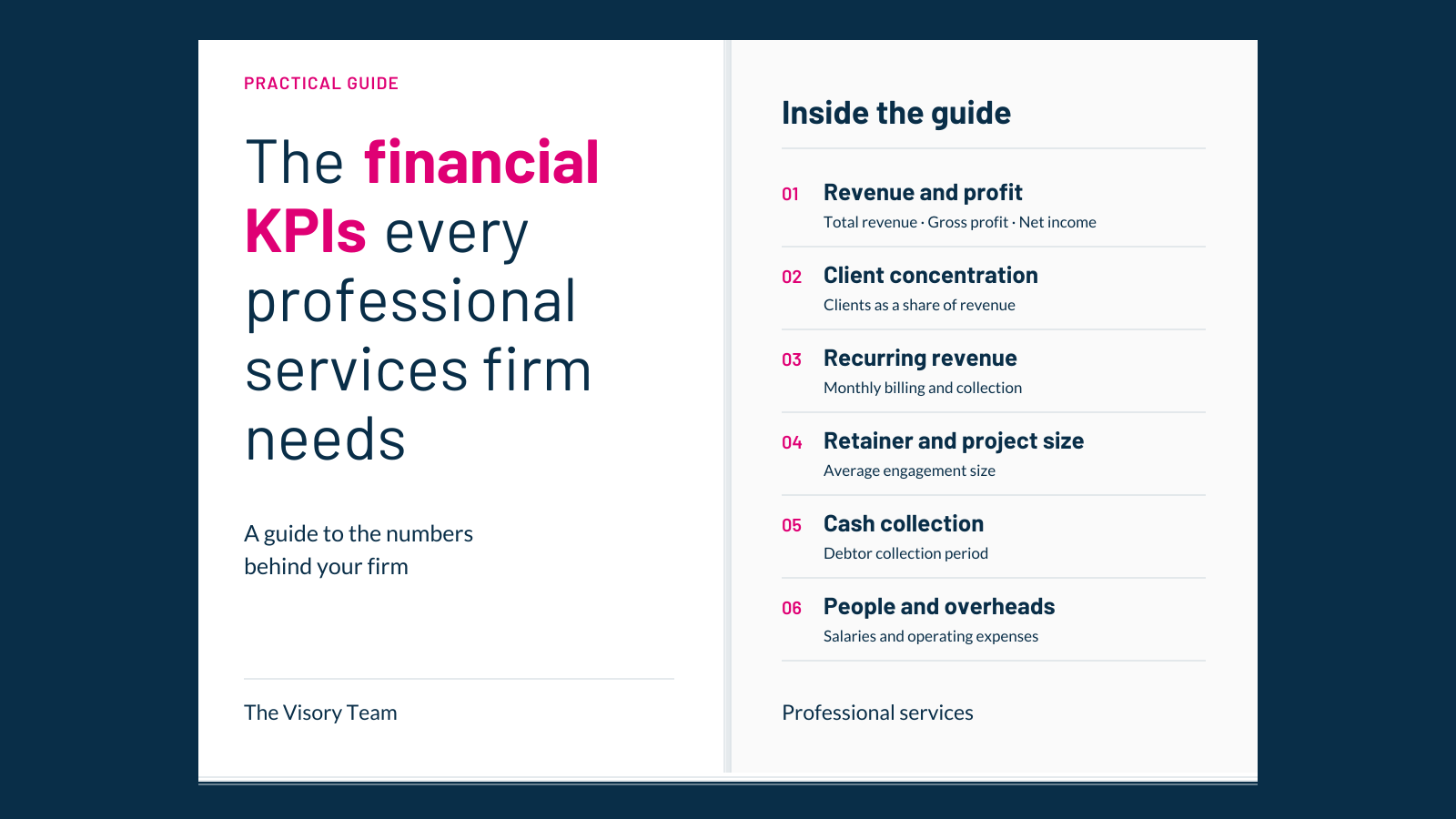
Content written for consulting firms by the expert teams at Visory.


Common questions
Straight answers for consulting firms.
The questions managing directors and principals ask before they hand Visory the finance function. The general ones are on the common questions page.
What is the difference between utilisation and realisation?
Utilisation is the share of a consultant’s available hours that is billable. Realisation is the share of that billable time, at standard rates, that reaches an invoice. A firm can be busy and still lose margin when realisation falls, through write-offs, discounts, or fixed fees that overrun. Visory reports both each month, by consultant and by engagement, from your timesheets and the ledger.
How do you account for retainers billed in advance?
A retainer invoiced before the work is done is held on the balance sheet as income received in advance, and moves into fees as the work is delivered. The revenue standard, AASB 15, calls this a contract liability. It stops a quarterly retainer billed in July from making July look like your best month. This describes how the books are kept; it is not tax advice.
How do fixed-fee engagements show up in the monthly numbers?
Fees on a fixed-fee engagement are recognised as the work progresses, measured against the engagement budget, so a project half done shows about half its fee, whatever has been invoiced. Work done ahead of billing sits as unbilled work, and billing ahead of the work sits as income in advance. Budget against actual hours is reported every month, so an overrun shows while there is still time to raise a variation.
Can you track work in progress and unbilled time?
Yes. At each month-end, unbilled time and expenses are read from your timesheet or engagement tool and reported beside the ledger, by engagement and by age. Time-and-materials work is billed at the rates you set, and milestones reached on fixed-fee work are flagged for an invoice once you approve it.
Do we pay super for associates who invoice us?
It depends on who you contract with. An individual paid mainly for their own labour is an employee for super guarantee purposes, even with an ABN, and super on the labour part of each invoice is due within seven business days of paying it. An associate who contracts through their own company, trust or partnership is not your employee for super. Visory checks each associate bill against the party on the contract and includes super where it applies. This is general information, not tax advice.
How do we know if an associate is really a contractor?
Two tests can apply. The Fair Work Act looks at the whole relationship and how it works in practice; for tax and super, the ATO reads the rights and obligations in the contract. A contractor earning above the contractor high income threshold can opt out of the Fair Work test in writing. The call is yours, with your legal adviser, and nothing here is legal advice. Visory keeps the record that informs it: who you engage, for how long, on what terms, and at what cost.
Are our consultants covered by an award?
Some are. Engineers and scientists doing professional work are covered by the Professional Employees Award, and so are IT professionals at firms principally in the IT industry. Many management and strategy consultants are award free, with the National Minimum Wage and the National Employment Standards as their floor. Your Payroll Officer records the award, or award-free status, for each person, and checks the salaries that sit close to the overtime exemption.
Will you raise and chase our client invoices?
Yes, in your name. Retainers go out on their schedule, time-and-materials invoices from approved timesheets, and fixed-fee claims at each milestone you sign off. Overdue invoices are followed up on a cadence you agree, and debtor days are reported by client each month, so a slow payer is raised before the next engagement with them starts.
How much does Visory cost?
Visory charges one flat monthly fee for the scope we agree. No timesheets, no hourly billing, no surprises. The fee reflects the services you take and the volume of work in your firm, from the size of the pay run to the number of client invoices and associate bills each month, so you know the monthly cost before you start.
See how pricing works More questions, longer answers. Every question has its own link. See all common questions
General information for consulting firms, not financial or tax advice.
Getting started
Start with clarity, not a contract.
Three steps, in whatever rhythm suits you. Each one is useful on its own.
-

Book a discovery call
An obligation-free conversation about how you price engagements, how you use associates, and what you want the numbers to show.
Obligation-free -

Get your free financial health check
A senior member of the Visory team analyses your financials and shows where your finance function can improve. See the clarity before you commit to anything.
Free · your own numbers -
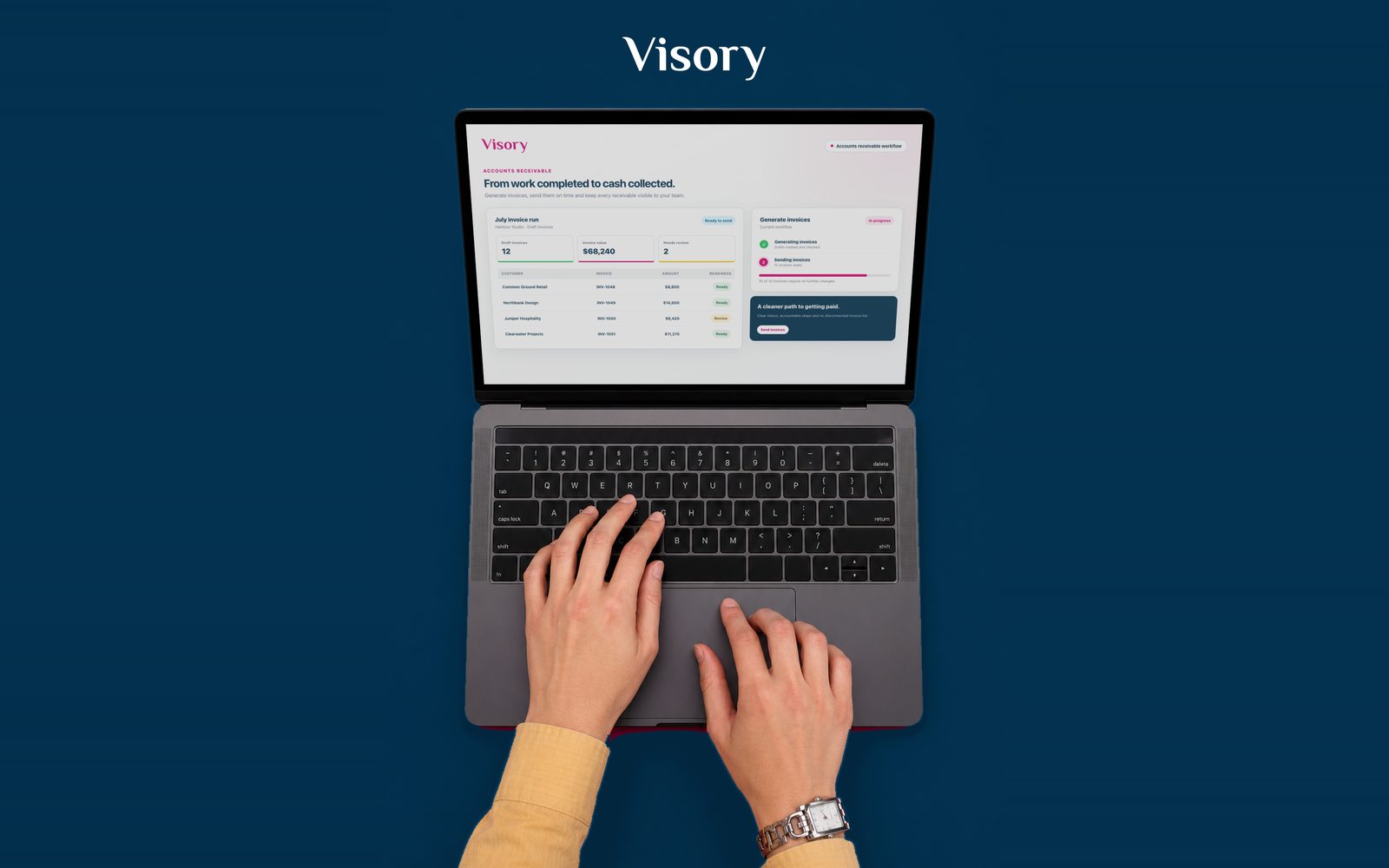
See how Visory works in practice
A walkthrough of the books, the pay run, and the monthly read on a firm of your shape. If it fits, we agree a flat monthly scope.
Flat monthly fee
Get started
Price the next engagement on what the last one cost.
Start with a discovery call. A senior member of the Visory team then runs the free financial health check on your own numbers and shows you where billable time stops short of an invoice.
Sources (8) · rules last checked 8 October 2026
- Fair Work Act 2009, section 15AA: the real substance, practical reality and true nature of the relationship, including how the contract is performed in practice; sections 15AB to 15AD and 15C: opt out notices for contractors above the contractor high income threshold; all effective 26 August 2024.
- Australian Taxation Office, Taxation Ruling TR 2023/4, Income tax and superannuation guarantee: who is an employee?, applying CFMMEU v Personnel Contracting Pty Ltd [2022] HCA 1.
- Superannuation Guarantee (Administration) Act 1992, section 12(3): a contract wholly or principally for a person’s labour; Australian Taxation Office, Super for independent contractors: contracts with a company, trust or partnership excluded.
- Australian Taxation Office, Payday Super: contributions received within seven business days of payday, and for contractors paid by invoice the payday is the date the invoice is paid, effective 1 July 2026.
- Taxation Administration Act 1953, Schedule 1, section 12-35 (withholding from payments to employees) and section 12-190 (withholding where no ABN is quoted); Australian Taxation Office, Taxation Ruling TR 2002/9.
- Professional Employees Award 2020 (MA000065), clause 4.1 (coverage) and clause 18 (overtime, penalty rates, record keeping, and the exemption for salaries 25% or more above the award minimum), as varied from 16 September 2023.
- Fair Work Act 2009, National Employment Standards; Fair Work Commission, Annual Wage Review and the National Minimum Wage for award and agreement free employees, effective each 1 July.
- Australian Accounting Standards Board, AASB 15 Revenue from Contracts with Customers, paragraphs 35 and 105 to 107: revenue recognised over time, contract assets and contract liabilities; for annual periods beginning on or after 1 January 2018.