
35% ▲ +3.0 pts since April
For hospitality groups
Know what every venue really made, every month.
Visory runs bookkeeping, payroll, accounts payable and accounts receivable for Australian hospitality groups and franchise QSR operators, with a dedicated team and Delphi AI under their oversight. Once a month, Visory Insights reads margin venue by venue and shows what to change.
- Takings reconciled venue by venue, from the POS to the bank: card settlements, delivery payouts, and cash banked, so each venue’s sales are clear each week.
- Every weekly pay run owned by a named Payroll Officer, checked by Delphi AI before it is paid: the right award for each venue, penalty rates, late-hour loadings, and super within seven business days.
- Wage cost and cost of goods by venue every month, briefed by your Business Performance Partner, in plain English, with one move to make.


Who this is for
Built for groups where every venue runs its own week.
Several venues, one owner, and a pay run that changes with every roster. That is the group Visory is built for.
- Two to twenty venues: cafés, restaurants, bars, pubs, or quick-service outlets, often each in its own company.
- Roughly $750k to $20m in revenue across the group, led by an owner, CEO, or managing director who answers for the result.
- A casual-heavy workforce on the Restaurant, Hospitality, or Fast Food award, paid weekly.
- A POS in every venue, supplier invoices every week, and the finance done after close by a part-time bookkeeper or an operations manager.
Anywhere in Australia. Venues in different cities and states report into one team, on one close timetable.
The pressure
Four rules set your wage bill and your takings. You set none of them.
Penalty rates follow the calendar, super follows payday, and the cost of taking cards sits in your prices, not on the bill. The finance function is where a group sees what each rule costs each venue, or finds out at year-end.
Wage cost follows the roster, not the sales.
For permanent staff, a Sunday shift costs half as much again as a Tuesday shift, so wage cost has to be read venue by venue and day by day, not as one number for the group.
Set by Restaurant and Hospitality awards
Under both awards, full-time and part-time staff are paid 125% of their rate on a Saturday, 150% on a Sunday, and 225% on a public holiday. Casuals are paid from their own column of rates, which includes their loading, and late hours Monday to Friday add a flat amount per hour, which the Annual Wage Review resets each 1 July.
Restaurant Industry Award 2020 (MA000119), clause 24; Hospitality Industry (General) Award 2020 (MA000009), clause 29; as varied, effective 1 July 2026.The roster, the timesheet, and the payslip have to agree.
On a weekly cycle across several venues, that check happens every week, and the records behind it are what a Fair Work Inspector can ask to see.
Set by Fair Work Act and Regulations
Employers keep time and wages records for seven years, including the hours worked by each casual and irregular part-time employee and every penalty rate and loading paid, and give each employee a payslip within one working day of payday.
Fair Work Act 2009, sections 535 and 536; Fair Work Regulations 2009, regulations 3.33 and 3.46; in force since 1 July 2009.A weekly pay run is a weekly super run.
For a casual workforce that changes shift by shift, the contribution is calculated and paid inside the week, for every venue.
Set by Payday Super
Super guarantee contributions must be received by each employee’s fund, with the details needed to allocate them, within seven business days after payday. Late contributions attract the super guarantee charge, and the Small Business Superannuation Clearing House is closed.
Australian Taxation Office, Payday Super guidance; effective 1 July 2026.Merchant fees become a cost each venue carries.
They belong in each venue’s margin, read against its card takings every month, and in the menu price when it is next set.
Set by Reserve Bank card reforms
Surcharges on debit, prepaid, and credit cards on the eftpos, Mastercard, and Visa networks are not permitted under the networks’ no-surcharge rules, which the Reserve Bank allowed by varying its merchant pricing standard. The cost of accepting cards is recovered through prices instead.
Reserve Bank of Australia, Review of Merchant Card Payment Costs and Surcharging, Conclusions Paper; Standard No. 3 of 2016, as varied; effective 1 October 2026.Every instrument named here is listed with its effective date at the foot of this page.
What the owner sees each month
Four numbers for the group, with every venue behind them.
Sales, last quarter $2.25m ▲ 2% ahead of budget By venue, from POS takings reconciled to the bank
Wage cost, share of sales 35% ▲ 3 pts above the 32% target Wages, penalty rates, and super, as a share of sales
Cost of goods, share of sales 29% Within the 28 to 30% range Food and beverage purchases, by venue
Cash across venues $410k Held · above the $300k floor The group’s bank balances after committed supplier runs
What did last Sunday cost each of your venues? A senior member of the Visory team can show you on your own numbers, before anything is agreed.
Book a discovery callWhat we run for hospitality groups
From accurate processing to leadership confidence.
Visory Insights leads. The basics underneath it make it trustworthy and free your team for the work that matters, run by a dedicated team with Delphi AI under their oversight.Flat monthly fee. No hourly billing.
- 1 Accurate processing Bookkeeping and payroll done right, every month.
- 2 Clean, reliable data The foundation that makes reporting defensible.
- 3 Meaningful insights Cash, margin, and the year ahead, explained.
- 4 Leadership confidence You present numbers you trust. The plan gets backed.
The leading service
Visory Insights
Wage cost and cost of goods by venue, explained once a month with one move to make. A named partner who reads each venue’s numbers with you and helps decide where the next dollar goes.
See how Visory Insights works- Monthly plain-English report
- Structured session with your leadership team
- Twelve-month forward view of cash
- A named Business Performance Partner
The basics underneath it
Bookkeeping
Each venue’s POS takings, card settlements, delivery-platform payouts, and cash banked reconciled to the ledger, so sales by venue are clear each week.
Explore bookkeepingPayroll
Weekly pay runs on the right award for each venue, with penalty rates, late-hour loadings, Single Touch Payroll, and super inside seven business days.
See how payroll runsAccounts payable
Invoices from produce, meat, beverage, and liquor suppliers captured, coded to the venue, and paid when you say so, with price rises made visible.
See accounts payableAccounts receivable
Function deposits, event invoices, and corporate accounts issued and followed up in your name.
See accounts receivableRosters and stocktakes stay with your venues. Your managers roster and count stock in the tools they already use, and Visory runs the pay run and the books from what those tools record.
Visory Insights for hospitality groups
One month of Visory Insights, venue by venue.
Reports tell you what happened. Visory Insights tells you what it means, and what to do about it. Here is one month for Saltbush Hospitality, a fictional group of five venues at about $9m in revenue with 140 staff.
Sales are holding. The gap is hours rostered past what the trade needed, most of them on Sundays. Three points of wage cost on $9m is $270k a year.
Hours rostered past the sales forecast, this quarter 1,600 At Risk 1,000 hours past the 600 the roster model allows for training and events: Sunday shifts at the two cafés, and a second closing shift at the bar Monday to Thursday
Wage cost, share of sales Taking out those 1,000 hours is worth about $45,000 a quarter and moves wage cost two points back toward the 32% target
Roster the cafés’ Sundays to the sales forecast, and drop the bar’s second closing shift Monday to Thursday. About 1,000 of the 1,600 hours. Hours by venue, day, and shift are prepared for your session.
≈ +$180k a year Insight session Accepted 9:00 to 9:45am · Video call  With your Business Performance Partner
With your Business Performance Partner
Prepared by Delphi AI, briefed by your Business Performance Partner, in plain English, with every venue on its own line. No guesswork.
- Monthly plain-English report
- Structured insight sessions
- Wage cost and cost of goods, venue by venue
See your venues side by side. A discovery call is a conversation about your venues, your rosters, and what you want the monthly read to show you.
Book a discovery callFits your stack
Works with the tools you already use.
Your ledger and your payroll stay where they are. Visory connects to them and keeps the data flowing every day, so your team and Delphi are working from current numbers.
Accounting and books
Where your ledger and reporting live.


Payroll and people
Pay runs, Single Touch Payroll reporting, and the people behind them.
-

-
 Xero Payroll
POS, timesheets, and suppliers
Whichever POS each venue runs, its takings are matched to card settlements and the bank through daily feeds. Your rostering and timesheet tool feeds the pay run, and supplier invoices come in from email or your ordering platform.
Resources for hospitality groups
Content written for hospitality groups by the expert teams at Visory.



Common questions
Straight answers for hospitality groups.
The questions owners and operators ask before they hand Visory the finance function. The general ones are on the common questions page.
Which award covers our venues?
It depends on what each venue is. Hotels, taverns, wine bars, and the restaurants inside them are covered by the Hospitality Industry (General) Award. Standalone restaurants, cafés, reception centres, and night clubs are covered by the Restaurant Industry Award. Takeaway and food-court outlets are usually covered by the Fast Food Industry Award, and registered clubs have their own. A group with a pub and two cafés can run two awards at once, so your Payroll Officer confirms the award for each venue and the classification for each role before the first pay run.
Can you run hospitality payroll with penalty rates?
Yes. Delphi AI prepares and checks each weekly run from your approved timesheets, under your Payroll Officer: weekend and public holiday rates, late-hour loadings, casual loading, and the two-hour minimum engagement for casuals. You approve it, it is paid and reported through Single Touch Payroll, and super is sent within seven business days. Both awards also rule out paying wages on a Friday, Saturday, or Sunday except in limited cases, so pay day is set to fit.
What should wage cost be as a percentage of sales?
There is no single right number. A café, a pub, and a quick-service outlet carry different wage costs, and the same venue runs differently on a Sunday than on a Tuesday. Your Business Performance Partner sets a target with you for each venue, and Visory Insights reads every venue against its own target each month, so the conversation is about which shifts moved it.
Can you reconcile our POS takings to the bank?
Yes. Each venue’s daily takings from the POS are matched to card settlements, delivery-platform payouts net of their commission, and cash banked. Anything that does not match is raised with the venue while the day is still fresh, so sales in the ledger are the sales that reached the bank.
How do you handle supplier invoices across several venues?
Every invoice is captured, coded to the venue and to food, beverage, or consumables, and paid on the schedule you approve. Price rises show up as they land rather than at stocktake, and cost of goods is reported by venue each month.
Can we still add a surcharge for card payments?
Not on eftpos, Mastercard, or Visa cards. Under the Reserve Bank’s card reforms, those networks’ no-surcharge rules apply from 1 October 2026, so the cost of accepting cards is recovered through prices. Visory shows each venue’s merchant fees against its card takings every month, so you can see what cards cost before the next menu change. This is general information, not legal advice.
Each venue is its own company. Can you handle that?
Yes. Each company keeps its own ledger, its own payroll, and its own bank feeds, closed on the same timetable. Charges between venues, such as shared staff or a central kitchen, are recorded both ways, and the monthly read shows each venue on its own and the group as one.
What pay records does Fair Work expect us to keep?
Time and wages records for seven years, including the hours worked by every casual and irregular part-time employee and each penalty rate and loading paid, and a payslip for each employee within one working day of payday. Visory keeps the pay records with each run, so they are ready if a Fair Work Inspector asks.
How much does Visory cost?
Visory charges one flat monthly fee for the scope we agree. No timesheets, no hourly billing, no surprises. The fee reflects the services you take and the volume of work in your group, from the number of venues and the size of the weekly pay run to the invoices and payments each week, so you know the monthly cost before you start.
See how pricing works More questions, longer answers. Every question has its own link. See all common questions
General information for hospitality groups, not financial or tax advice.
Getting started
Start with clarity, not a contract.
Three steps, in whatever rhythm suits you. Each one is useful on its own.
-

Book a discovery call
An obligation-free conversation about your venues, your rosters, and what you want each venue’s numbers to tell you.
Obligation-free -

Get your free financial health check
A senior member of the Visory team analyses your financials and shows where your finance function can improve. See the clarity before you commit to anything.
Free · your own numbers -
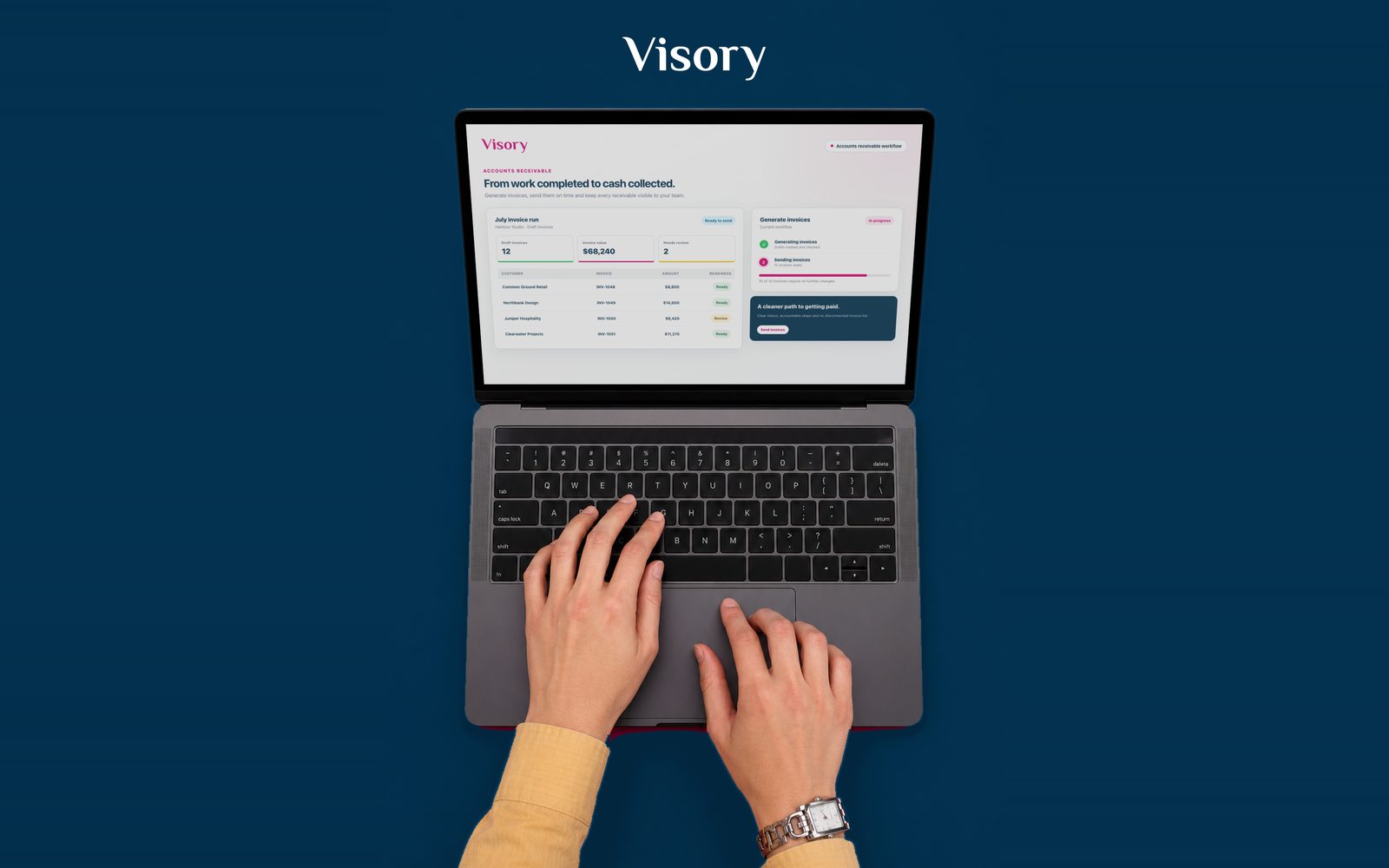
See how Visory works in practice
A walkthrough of the finance function and Insights working together on a group like yours. If it fits, we agree a flat monthly scope.
Flat monthly fee
Get started
Know what each venue made before the next roster is set.
Start with a discovery call. Then a senior member of the Visory team analyses your numbers, free of charge, and shows you where the finance function can improve.
Sources (7) · rules last checked 8 October 2026
- Restaurant Industry Award 2020 (MA000119): clause 4, coverage; clause 11.3, casual minimum engagement; clause 19.2, pay day; clause 24, penalty rates, as varied effective 1 July 2026.
- Hospitality Industry (General) Award 2020 (MA000009): clause 4, coverage; clause 11.3, casual minimum engagement; clause 23.2, pay day; clause 29, penalty rates, as varied effective 1 July 2026.
- Fast Food Industry Award 2020 (MA000003): clause 4, coverage.
- Fair Work Commission, Annual Wage Review, effective each 1 July.
- Fair Work Act 2009, sections 535 and 536, and Fair Work Regulations 2009, including regulations 3.33 and 3.46: time and wages records kept for seven years; payslips within one working day; in force since 1 July 2009.
- Australian Taxation Office, Payday Super: contributions received within seven business days of payday, effective 1 July 2026.
- Reserve Bank of Australia, Review of Merchant Card Payment Costs and Surcharging, Conclusions Paper, and Standard No. 3 of 2016 as varied: no surcharges on eftpos, Mastercard, and Visa cards, effective 1 October 2026.