
83% ▲ +3.0 pts since April
For NDIS providers
Books, award payroll and cash flow your team can plan around.
Visory runs bookkeeping, payroll, accounts payable and accounts receivable for Australian NDIS providers, with a dedicated team and Delphi AI under their oversight. Once a month, Visory Insights shows how cash, payroll and each service line are tracking, and what to do next.
- Every payment reconciled into the books, from the NDIA, plan managers and self-managed participants, so cash received is clear each week. Claims stay with your team.
- Every SCHADS pay run owned by a named Payroll Officer, checked by Delphi AI before it is paid: broken shifts, sleepovers, minimum engagements, and super within seven business days.
- Margin by service line every month, briefed by your Business Performance Partner, in plain English, with one move to make.

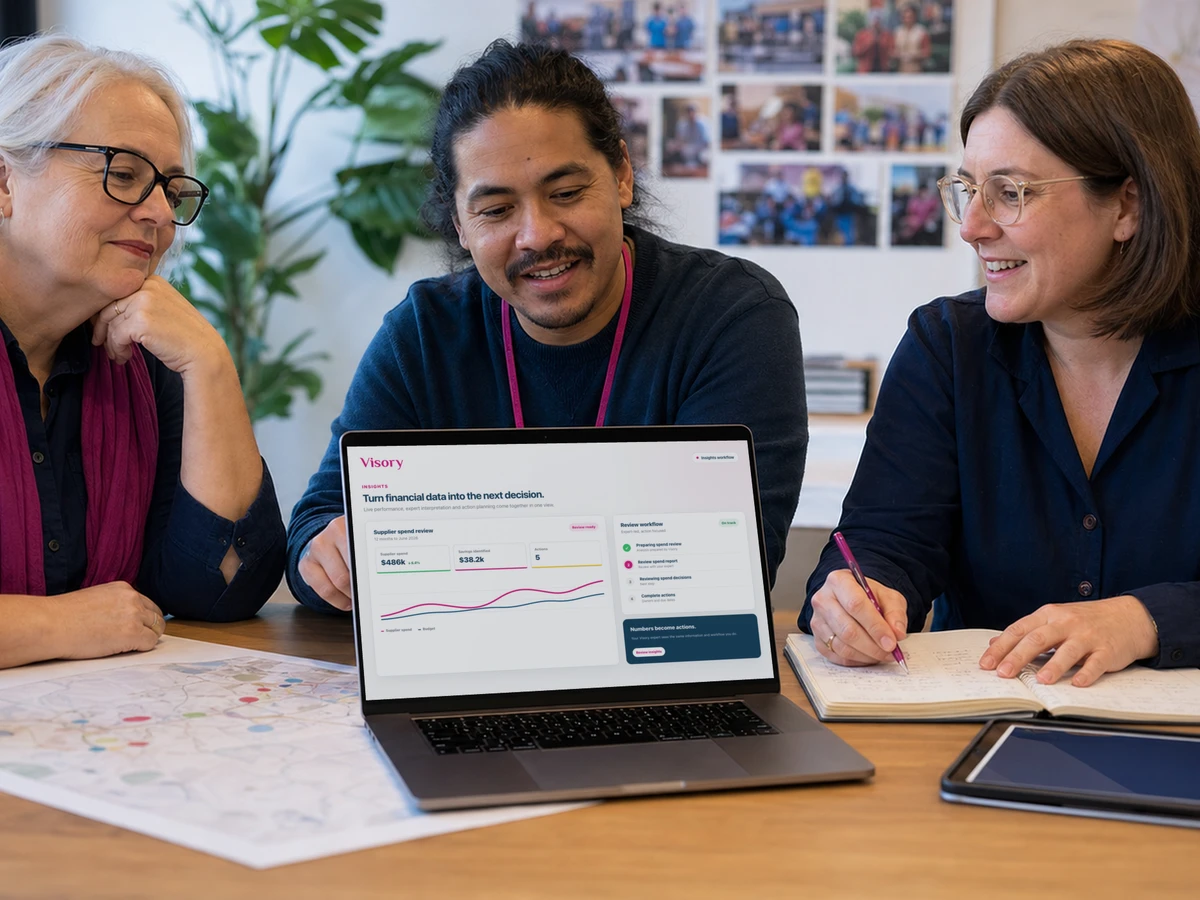
Who this is for
Built for providers where wages are the biggest line.
If your month runs on rosters, claims, and a pay run that has to be right, this is the finance function for it.
- Registered or unregistered providers delivering core supports, supported independent living, community participation, or allied health.
- Not-for-profit or community-owned, roughly $750k to $20m in revenue, led by a CEO who answers to a board for the result.
- A workforce on the SCHADS Award, paid weekly or fortnightly, with rostering that changes daily.
- Revenue that arrives three ways: NDIA-managed claims, plan-manager invoices, and self-managed participants.
Anywhere in Australia. Providers in every state and in the regions work with the same team, on the same monthly rhythm.
The pressure
Four rules set your month. None of them is set by you.
Price limits are set outside your business and reset once a year. Wages, super, and claiming rules move on their own dates. The finance function is where the gap between revenue you cannot set and costs you cannot stop gets managed, or missed.
Your revenue ceiling is a document that changes once a year.
Every point of margin has to come from cost, utilisation, and claiming discipline.
Set by NDIS Pricing Schedule
Under the amended NDIS Act, the Minister sets maximum prices for NDIA-managed and plan-managed participants by determination: the NDIS Pricing Schedule. It replaced the NDIA’s Pricing Arrangements and Price Limits, which providers knew as the price guide, and it resets each financial year.
NDIS Act 2013, section 45C; NDIS Pricing Schedule, effective 24 September 2026.Lodging rhythm becomes a cash control.
Your team lodges the claims. Visory reconciles every payment that lands into the books, so cash received is clear each week and the ledger behind it is kept for the full seven years.
Set by NDIS Act, as amended
The Securing the NDIS for Future Generations Act 2026 sets the window to lodge a claim at 90 days from the support being delivered, and requires providers to keep the record behind each claim for seven years, with a civil penalty for failing to.
Act No. 66 of 2026, Schedule 2, Parts 4 and 5; record keeping effective 27 August 2026, claim window effective 1 December 2026.Wage costs can rise months before the price schedule does.
Each step lands in a pay period, so classifications, rosters, and the pay run have to be right that week, and the gap has to be modelled before it, not discovered after it.
Set by SCHADS Award
The Social, Community, Home Care and Disability Services Industry Award sets classifications, minimum engagements, broken shifts, sleepovers, and allowances. Minimum rates rise every 1 July with the Annual Wage Review, and the Fair Work Commission can vary a stream’s rates on its own dates, as it has for home care employees who provide disability care.
SCHADS Award (MA000100); Annual Wage Review, effective each 1 July; Fair Work Commission, [2026] FWCFB 232.A weekly pay cycle means weekly super.
For a casual workforce on penalty rates and allowances, the calculation and the payment both have to happen inside the week, every week.
Set by Payday Super
Under Payday Super, super guarantee contributions must reach the fund within seven business days of each payday. The Small Business Superannuation Clearing House has closed, and the charge applies to late contributions.
Australian Taxation Office, Payday Super guidance; effective 1 July 2026.Every instrument named here is listed with its effective date at the foot of this page.
Where does your margin sit before the next rate change lands? A senior member of the Visory team can show you on your own numbers, before anything is agreed.
Book a discovery callWhat we run for NDIS providers
From accurate processing to leadership confidence.
Visory Insights leads. The basics underneath it make it trustworthy and free your team for the work that matters, run by a dedicated team with Delphi AI under their oversight.Flat monthly fee. No hourly billing.
- 1 Accurate processing Bookkeeping and payroll done right, every month.
- 2 Clean, reliable data The foundation that makes reporting defensible.
- 3 Meaningful insights Cash, margin, and the year ahead, explained.
- 4 Leadership confidence You present numbers you trust. The plan gets backed.
The leading service
Visory Insights
Margin by service line, unfunded hours, and cancellations, explained once a month with one move to make. A named partner who knows the sector’s numbers and walks you through yours before the next rate change lands.
See how Visory Insights works- Monthly plain-English report
- Structured session with your leadership team
- Twelve-month forward view of cash
- A named Business Performance Partner
The basics underneath it
Bookkeeping
Every NDIA payment, plan-manager payment, and participant receipt reconciled to the ledger, so the books show what has landed and when.
Explore bookkeepingPayroll
Pay runs built on the SCHADS Award, from broken shifts and sleepovers to Single Touch Payroll and super inside seven business days.
See how payroll runsAccounts payable
Supplier bills and contractor invoices captured, checked, and paid when you say so.
See accounts payableAccounts receivable
Invoices to plan managers and self-managed participants issued and followed up in your name.
See accounts receivableNDIS claims stay with your team. Your staff lodge them through the provider portal from your own delivery records, and Visory reconciles the payments into the books once they land.
Visory Insights for NDIS providers
One insight, start to finish, on a provider’s numbers.
Reports tell you what happened. Visory Insights tells you what it means, and what to do about it. Here is one month for Eastside Community Care, a fictional provider at about $6m in revenue with 70 support workers.
Pay rates are flat. The driver is hours delivered that never became a claim. Three points of staff cost on $6m is $180k a year.
Unfunded hours, this quarter 310 At Risk 190 hours past the 120 the roster allows for travel and notes: travel over the cap, late cancellations left unclaimed, notes written off-shift
Staff cost, share of revenue Claiming 230 of the 310 hours is worth about $17,000 a quarter and moves staff cost a point back toward the 80% target
Claim the short-notice cancellations the service agreements already allow, and reschedule the two longest travel runs. About 230 of the 310 hours. The cancellation wording and the roster change are prepared for your session.
≈ +$68k a year Insight session Accepted 9:00 to 9:45am · Video call  With your Business Performance Partner
With your Business Performance Partner
Prepared by Delphi AI, briefed by your Business Performance Partner, in plain English, in a structured session, monthly or quarterly. No guesswork.
- Monthly plain-English report
- Structured insight sessions
- Early sight of unfunded hours and margin by service line
See this on your own numbers. A discovery call is a conversation about your participants, your roster, and what you want the monthly read to tell you.
Book a discovery callFits your stack
Works with the tools you already use.
Your ledger and your payroll stay where they are. Visory connects to them and keeps the data flowing every day, so your team and Delphi are working from current numbers.
Accounting and books
Where your ledger and reporting live.


Payroll and people
Pay runs, Single Touch Payroll reporting, and the people behind them.
-

-
 Xero Payroll
Payments, plan managers, and rostering
NDIA, plan-manager, and participant payments matched to the ledger through daily bank feeds. Your rostering tool stays where it is and feeds the pay run through your payroll system.
Resources for NDIS providers
Content written for NDIS providers by the expert teams at Visory.



In their words
What NDIS providers say about Visory.
“Visory is a partner who provides opportunities and levers to try and build the business on - outcomes-focused with strong Insights & Advisory.”
Common questions
Straight answers for NDIS providers.
The questions providers ask before they hand Visory the finance function. The general ones are on the common questions page.
Do you lodge our NDIS claims?
No. Claim lodgement stays with your team: you lodge through the NDIS provider portal from your own delivery records. Visory reconciles every payment that lands, from the NDIA, plan managers, and self-managed participants, into the books, so you can see what has been paid and when.
How long does the NDIA take to pay?
Valid claims from a recorded provider are usually paid by the NDIA within two to three business days. Plan managers pay on their own terms, often weekly or fortnightly, and self-managed participants pay like any customer. The cash gap is rarely the NDIA; it is claims lodged late, invoices bounced for a missing support item or date, and plan-manager invoices nobody followed up. Visory follows up plan-manager and participant invoices in your name and reconciles every payment that lands, so you can see what has arrived.
Can you run SCHADS payroll properly?
Yes. A Payroll Officer runs every pay cycle on the Social, Community, Home Care and Disability Services Industry Award: minimum engagement periods, broken shift allowances, sleepovers, shift loadings, and the vehicle allowance. Delphi AI prepares and checks the run from your rostering data, your Payroll Officer oversees it, you approve it, and it is paid, reported through Single Touch Payroll, and the super sent within seven business days.
What happens when SCHADS rates change?
Award rates move at least once a year with the Annual Wage Review, and the Fair Work Commission can change a stream’s rates or classifications on its own dates. Each time, your Payroll Officer reclassifies the workforce and runs the first pay cycle under the new rates, and your Business Performance Partner models the wage change against the price limits in force, so the margin effect is known before the pay run, not after it.
What happens with plan-managed and self-managed participants?
Each lane runs its own way. Plan-managed participants get an invoice sent to their plan manager, with the support item, dates, and hours they need, followed up in your name on a cadence you agree. Self-managed participants are invoiced directly and receipted once paid. NDIA-managed supports are claimed by your team through the portal. Payments from all three are reconciled into one ledger.
Is our NDIS income GST-free?
Usually, if four conditions are met: the participant has an NDIS plan in effect, the supply is of reasonable and necessary supports in that plan, there is a written agreement between you and the participant or their representative that identifies them and the supports, and the supply is of a kind covered by the GST-free NDIS supports determination. GST-free sales still count toward GST turnover, so a provider whose GST turnover passes $75,000 ($150,000 for a not-for-profit) has to register for GST, and once registered can claim credits on what it buys. Visory codes each supply in the ledger and prepares the BAS from it. This is general information, not tax advice.
What records will an auditor or the NDIA want from us?
Claim records for seven years from the day each claim is made, under the amended NDIS Act, and time and wages records for seven years under the Fair Work Act. Registered providers also need the evidence their Practice Standards audit asks for. Visory keeps the ledger reconciled to the payments received and the pay records to each run, so the finance side of the answer is already filed.
We are registered. Does that change the finance work?
Registration opens NDIA-managed participants to you, which means claims through the portal rather than invoices to a plan manager, and it brings a certification or verification audit against the Practice Standards from the NDIS Quality and Safeguards Commission, usually on a three-year cycle with a mid-term audit. In the books, more revenue arrives as portal payments, which Visory reconciles as they land, and the ledger and pay records the auditor asks for are kept ready.
Do you work with our rostering software?
Yes, whichever you run. Rostering tools push approved shifts into your payroll system, and Visory runs the pay run from there and the ledger from your accounting system. Your rostering, your ledger, and your payroll system all stay where they are.
How much does Visory cost?
Visory charges one flat monthly fee for the scope we agree. No timesheets, no hourly billing, no surprises. The fee reflects the services you take and the volume of work in your business, from the size of the pay run to the number of invoices and payments each week, so you know the monthly cost before you start.
See how pricing works More questions, longer answers. Every question has its own link. See all common questions
General information for NDIS providers, not financial or tax advice.
Getting started
Start with clarity, not a contract.
Three steps, in whatever rhythm suits you. Each one is useful on its own.
-

Book a discovery call
An obligation-free conversation about your goals and what you want the numbers to tell you.
Obligation-free -

Get your free financial health check
A senior member of the Visory team analyses your financials and shows where your finance function can improve. See the clarity before you commit to anything.
Free · your own numbers -
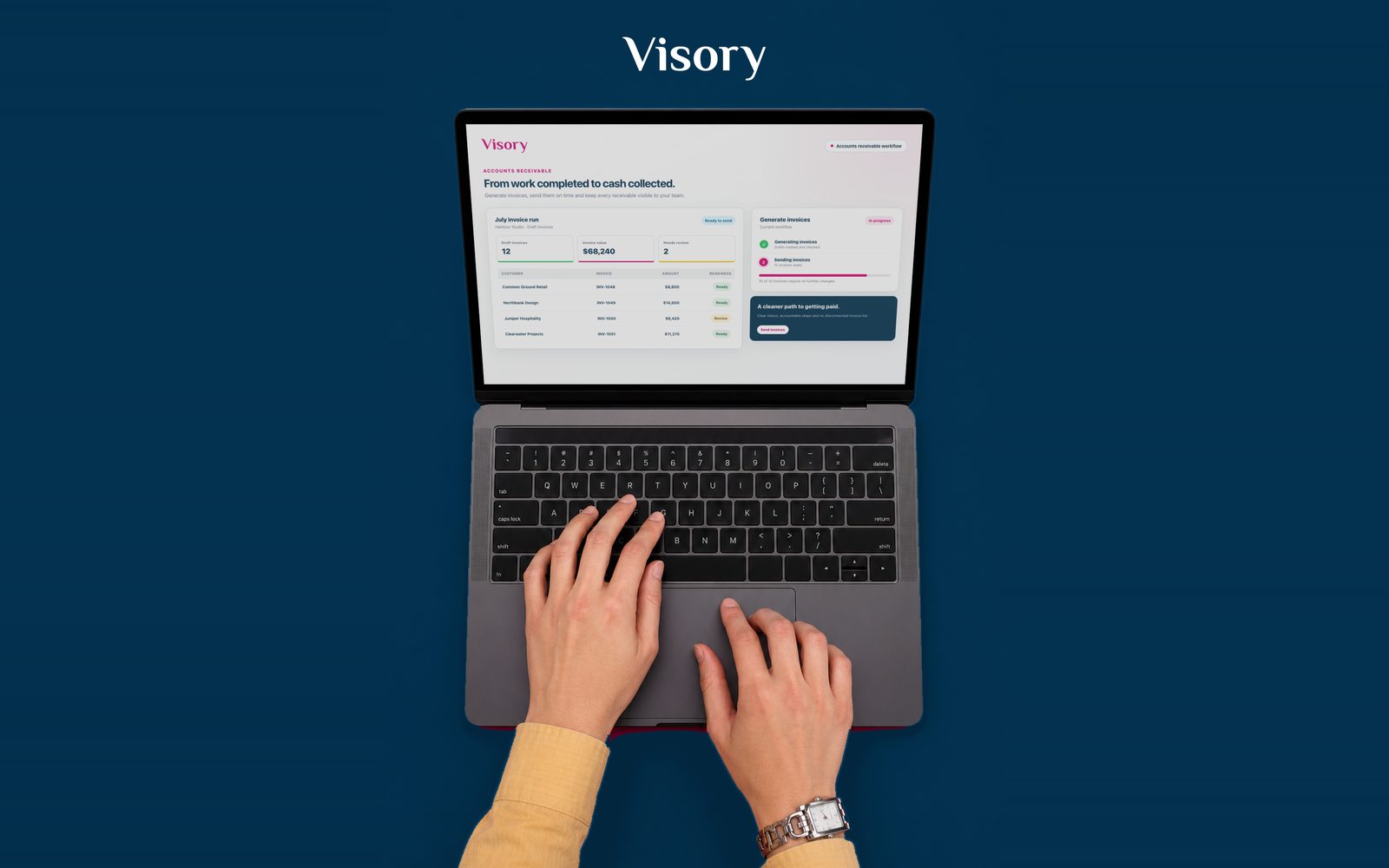
See how Visory works in practice
A walkthrough of the finance function and Insights working together on a provider like yours. If it fits, we agree a flat monthly scope.
Flat monthly fee
Get started
Know your margin before the next rate change does.
Start with a discovery call. Then a senior member of the Visory team analyses your numbers, free of charge, and shows you where the finance function can improve.
Sources (8) · rules last checked 8 October 2026
- NDIA, NDIS Pricing Schedule, made under the NDIS Act 2013, section 45C, effective 24 September 2026 and reset each financial year.
- Securing the NDIS for Future Generations Act 2026 (No. 66, 2026), Schedule 2, Parts 4 and 5: seven-year claim records, effective 27 August 2026; 90-day claim window, effective 1 December 2026.
- NDIA, Guide to getting paid: valid claims from recorded providers are usually paid within two to three business days.
- Social, Community, Home Care and Disability Services Industry Award 2010 (MA000100); Fair Work Commission, Annual Wage Review, effective each 1 July; Fair Work Commission, [2026] FWCFB 232, home care employees who provide disability care.
- Fair Work Act 2009 and Fair Work Regulations 2009: time and wages records kept for seven years.
- Australian Taxation Office, Payday Super: contributions received within seven business days of payday, effective 1 July 2026.
- Australian Taxation Office, GST and NDIS supports: A New Tax System (Goods and Services Tax) Act 1999, section 38-38, and the GST-free Supply (National Disability Insurance Scheme Supports) Determination; GST turnover includes GST-free sales.
- NDIS Quality and Safeguards Commission: registration, audit types, and the NDIS Practice Standards.