

Payroll in Sydney

Payroll services for Sydney businesses.

Visory provides payroll services for growing Sydney businesses. A named Payroll Officer runs every pay run remotely, inside your own Xero, MYOB or QuickBooks file: award interpretation, Single Touch Payroll, super and leave, with New South Wales payroll tax and long service leave built in. Delphi AI takes the repetitive parts, overseen by your team. One flat monthly fee covers the agreed scope.

  • A dedicated team you know by name
  • New South Wales rules in every pay run and close
  • One flat monthly fee for the agreed scope
Sydney’s skyline, the Opera House and the Harbour Bridge across the harbour from Cremorne Point.
Photo: Jesper van der Pol, Unsplash License

Payroll in Sydney

What every Sydney pay run covers.

A dedicated team prepares each pay run, checks it, and sends it to you to approve before anyone is paid. Six things are right every time.

  • Awards, applied Pay rates, penalties and allowances checked against the award or agreement each person is on.
  • Single Touch Payroll Every pay run reported to the ATO from your own payroll file, with nothing to re-key.
  • Super on time Super calculated with each pay run and paid on the cycle Payday Super sets from 1 July 2026.
  • Leave that adds up Annual, personal and long service leave accrued in the file, so balances are right when someone asks.
  • New South Wales payroll tax Wages reconciled every month, so your New South Wales return draws on the same numbers as your books.
  • Starters and leavers New starters set up properly and final pay worked out to the rules that apply.

New South Wales rules

The New South Wales rules every pay run works to.

Seven employer rules set by New South Wales, each with the instrument that sets it and what it does to your month. Your team works to them every pay run and every close.

Payroll and the books agree every month.

Once wages pass the threshold, a monthly return is due by the 7th and the annual reconciliation by 28 July, so each return should draw on reconciled payroll, not a year-end catch-up.

Set by Payroll Tax Act 2007 (NSW)

Payroll tax is 5.45% of New South Wales taxable wages above an annual threshold of $1,200,000. The threshold does not phase out as wages grow, but a business with wages in other states gets only its New South Wales share of it.

Payroll Tax Act 2007 (NSW); rate and threshold unchanged since 1 July 2022, including 2026-27.

The liability starts on day one.

Leave can fall due from year five, so it belongs in your balance sheet before it is triggered, and a resignation should never be a surprise.

Set by Long Service Leave Act 1955 (NSW)

Two months (about 8.67 weeks) of paid leave after 10 years of continuous service, then one month for each further 5 years. Between 5 and 10 years, pro rata leave is payable when employment ends in set circumstances, such as the employer ending it for any reason other than serious and wilful misconduct. Building and construction, contract cleaning and community services have portable schemes run by the Long Service Corporation.

Long Service Leave Act 1955 (NSW); community services portable scheme from 1 July 2025.

The holiday calendar changes from year to year.

Pay runs that cross these days need penalty rates and award conditions checked, and supplier payment runs move around them.

Set by Public Holidays Act 2010 (NSW)

New South Wales holidays include Easter Saturday and Easter Sunday, the King’s Birthday (the second Monday in June) and Labour Day (the first Monday in October), with an additional day when Christmas, Boxing Day or New Year’s Day falls on a weekend, and, in 2026 and 2027, when Anzac Day does (Monday 27 April 2026 and Monday 26 April 2027). The August Bank Holiday is not a public holiday for most businesses; it closes bank branches.

Public Holidays Act 2010 (NSW).

Declared wages should match payroll.

Clean monthly numbers turn the wage declaration into a check rather than a project.

Set by Workers Compensation Act 1987 (NSW) and Workplace Injury Management and Workers Compensation Act 1998 (NSW)

Employers must hold a workers compensation policy unless they pay $7,500 or less in wages a year, employ no apprentice or trainee, and are not part of a group. The icare Nominal Insurer is the largest insurer, and SIRA regulates the scheme. Actual wages are declared at the end of each policy period, within four months. The Nominal Insurer’s target collection rate is frozen at 1.99% for 2026-27 and 2027-28.

Workers Compensation Act 1987 (NSW) and Workplace Injury Management and Workers Compensation Act 1998 (NSW); 2026-27 premium year.

Registration turns on Australian wages for the whole group.

A growing business can owe New South Wales tax before its local payroll looks large.

Set by Payroll Tax Act 2007 (NSW)

A business that pays wages in New South Wales registers within 7 days after the month in which its total Australian wages, or its group’s, pass the monthly threshold: $101,918 for a 31-day month in 2026-27. Estimated tax above $20,000 a year is paid monthly.

Payroll Tax Act 2007 (NSW); 2026-27 monthly thresholds.

The levy rose by about a third in July.

Budgets set on the first-year rate now understate the cost of every covered worker, and each quarterly return needs wages coded the same way in payroll and the books.

Set by Long Service Corporation, community services scheme

Community services employers register with the Long Service Corporation, lodge quarterly service returns and pay a levy for eligible workers. The levy was 1.3% for the first year, 1 July 2025 to 30 June 2026, and returns to 1.7% from the second year.

Long Service Corporation, community services scheme; scheme from 1 July 2025; 1.7% from 1 July 2026.

Older pay calendars miss a holiday.

A calendar built before February 2026 has no public holiday on Monday 26 April 2027 unless someone adds it.

Set by Public Holidays Act 2010 (NSW)

When Anzac Day falls on a weekend in 2026 and 2027, New South Wales adds a public holiday on the following Monday: Monday 27 April 2026 and Monday 26 April 2027. The Government will review the arrangement in 2027.

Public Holidays Act 2010 (NSW); announced 15 February 2026.

Rules last checked 7 October 2026 against the sources at the foot of this page. General information only. It does not take your circumstances into account.

Beyond Sydney

Where the rules change across New South Wales.

The same team works with businesses in regional New South Wales. These are the places where a rate, a holiday or a declaration differs from Sydney.

Bar Beach and Merewether in Newcastle from the clifftop, with surf rolling in.
Photo: Michael, Unsplash License

Newcastle and the Hunter

Newcastle pays payroll tax exactly as Sydney does, but its Show Day and the bulk billing test for medical centres work differently.

  • Newcastle Show Day is a local event day, not a public holiday: Friday 27 February 2026 and Friday 26 February 2027 in the City of Newcastle. Staff get the day off or penalty rates only where an award, agreement or contract provides for it.
  • Medical centres here are outside metropolitan Sydney for the Bulk Billing Support Initiative, so the payroll tax rebate on GP contractor payments needs 70% of GP services bulk billed, not 80%.
  • New South Wales has no regional payroll tax rate: 5.45% above the same $1,200,000 threshold applies across the state.

Wollongong’s city centre beneath the Illawarra Escarpment and Mount Keira, across the water.
Photo: Michael Skopal, Unsplash License

Wollongong and the Illawarra

The Illawarra follows the Sydney holiday calendar and payroll tax, but its medical centres meet a lower bulk billing test.

  • Medical centres in Wollongong and Shellharbour are outside metropolitan Sydney for the Bulk Billing Support Initiative, so the payroll tax rebate needs 70% of GP services bulk billed, not 80%.
  • No local public holiday or local event day is declared for Wollongong, Shellharbour or Kiama in 2026 or 2027, so the statewide calendar applies.
  • New South Wales has no regional payroll tax rate, so an Illawarra employer lodges and pays as a Sydney employer does.

Central Coast

Central Coast employers share Sydney’s payroll tax and holidays, and their medical centres meet the lower regional bulk billing test.

  • Central Coast medical centres are outside metropolitan Sydney for the Bulk Billing Support Initiative, so the payroll tax rebate needs 70% of GP services bulk billed, not 80%.
  • No local public holiday or local event day is declared for the Central Coast in 2026 or 2027, so the statewide calendar applies.
  • New South Wales has no regional payroll tax rate, so a Gosford or Wyong employer lodges and pays as a Sydney employer does.

How it works from anywhere

Can a team outside Sydney run a Sydney business?

Yes. Visory’s head office is in Melbourne and its team works across Australia, so nothing about the work depends on where your office is.

Your own file

Your books stay in your own Xero, MYOB or QuickBooks file. Your team works inside it, so you see the same numbers they do, whenever you look.

A team you know by name

A dedicated team runs the work, led by a Business Performance Partner. You meet them by video call, and you always know who to ask.

New South Wales rules, built in

Visory’s head office is in Melbourne and its team works across Australia, with businesses throughout New South Wales. Your books stay in your own Xero, MYOB or QuickBooks file, and your team works inside it with you. Every pay run and every close is checked against the rules on this page.

Business hours, and the platform after them

Your team works 9am to 5pm Melbourne time on business days, all year round, and the Visory platform is open to you around the clock for documents, approvals and your numbers.

What customers say

In a customer’s words.

“Having Visory as a flexible partner to handle our day-to-day has meant real relief for our CFO. From an economies of scale perspective, the outsourced model is cost-effective compared to bringing someone in-house, and the handoff to our external accountant for tax has been noticeably smoother than it was before.”

Hiram Ng CEO, Equisent Group

Common questions

Questions Sydney businesses ask.

Straight answers about payroll for a Sydney business, from a team that works remotely.

Does Visory have a payroll office in Sydney?

Visory’s head office is in Melbourne and our team works across Australia, so we run payroll for businesses in Sydney as we do everywhere else. Your Payroll Officer is named, works inside your own Xero, MYOB or QuickBooks file and meets you by video call. Pay runs, Single Touch Payroll reporting and super all happen in your own systems.

What hours does my payroll team work in Sydney time?

Your payroll team works 9am to 5pm Melbourne time, all year round, on business days. In Sydney that is 9am to 5pm all year, because Sydney and Melbourne change their clocks for daylight saving together. Outside those hours, the Visory platform is your 24/7 access point, so your payroll information is there whenever you need it.

Can you run award payroll for a Sydney business?

Yes. Your Payroll Officer sets up each employee under the award or agreement that covers the work, with penalty rates, allowances and casual loading applied every pay run. You approve the pay run before it is paid. New South Wales public holidays, including the extra Anzac Day Monday in April 2027, are set in the pay calendar.

Do you report through Single Touch Payroll?

Yes. Every pay run is reported to the ATO through Single Touch Payroll on or before payday, from your own payroll software. Your Payroll Officer checks the variations before you approve the pay run, and finalises the year’s data by the due date so employees see complete income statements.

When does super have to be paid now?

Since 1 July 2026, under Payday Super, contributions must reach the employee’s fund within seven business days of each payday, with 20 business days for a new employee’s first contribution. Visory calculates super with every pay run, so it can be paid on that cycle rather than at the end of the quarter.

When does a business register for New South Wales payroll tax?

Within 7 days after the month in which its total Australian wages, or its group’s, pass the monthly threshold: $101,918 for a 31-day month in 2026-27. Monthly returns follow by the 7th. The returns draw on the same reconciled payroll your Payroll Officer runs.

We run a community services organisation. What changed in 2026?

The Long Service Corporation’s community services levy returned to 1.7% of eligible workers’ wages on 1 July 2026, after a 1.3% first year. Employers lodge quarterly service returns. Your Payroll Officer keeps the wages and service data each return depends on, so what you report agrees with payroll and the books.

How do wages for workers compensation get declared?

At the end of each policy period, a New South Wales employer declares actual wages to its insurer within four months. An employer who does not declare risks a higher estimate. Your team keeps payroll reconciled to the books every month, so the figures behind the declaration are ready when your insurer asks.

Can you run payroll for staff in more than one state?

Yes. Your Payroll Officer runs one payroll across states, with each employee on the right state’s public holidays and long service leave rules. Payroll tax is worked out state by state, and a business with wages in several states gets only a share of each threshold, so every state’s return draws on the same wages.

More questions, longer answers. Every question has its own link. See all common questions

Getting started

Start with clarity, not a contract.

Three steps, in whatever rhythm suits you. Each one is useful on its own.

  1. Two people shake hands across a desk beside a laptop

    Book a discovery call

    An obligation-free conversation about your goals and what you want the numbers to tell you.

    Obligation-free
  2. A woman takes notes beside a laptop showing a financial report

    Get your free financial health check

    A senior member of the Visory team will analyse your financials and show you where your finance function can improve. It is free, and it is your own numbers.

    Free · your own numbers
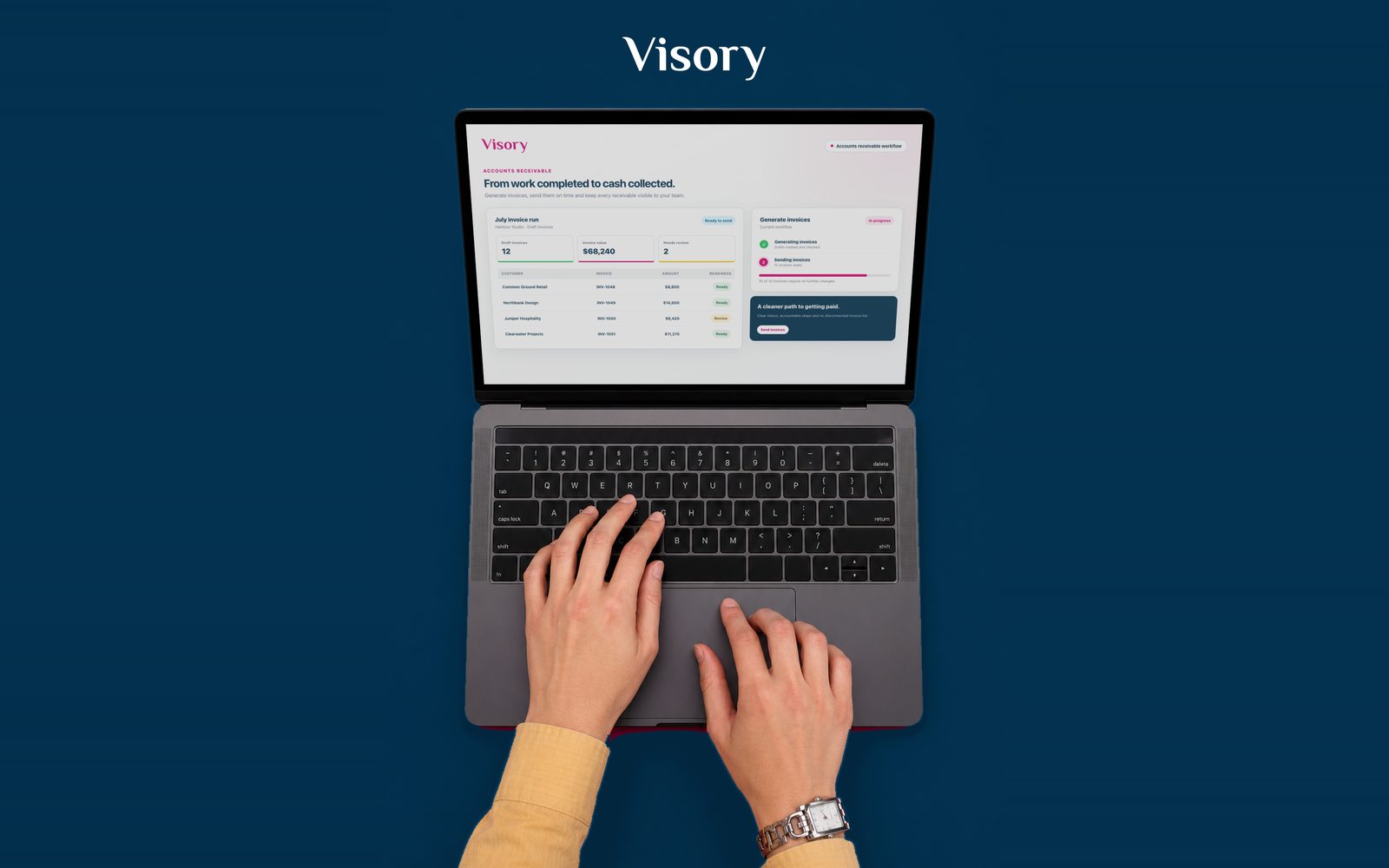
  3. Top-down view of hands on a laptop showing the Visory accounts receivable workflow

    Receive a clear proposal

    A clear commercial proposal for the scope we agree, on one flat monthly fee. No hourly billing. You decide whether to go ahead.

    Flat monthly fee

Get started

The best is ahead for your business.

Start with a discovery call. We will listen first, then show you what your own numbers have been trying to tell you.

Sources (16) · rules last checked 7 October 2026

A different Visory region may suit you

You’re viewing Visory AU. Would you like to visit Visory US?